
“AI will kill all the lawyers.”
That’s the headline The Spectator ran, and it makes for a great line. It also starts to sound less outrageous when you look at how quickly AI adoption is accelerating across the legal industry.
According to 8am’s 2026 Legal Industry Report, 69% of legal professionals now use general-purpose AI tools at work—more than double the 2025 figure. At the same time, Clio’s data shows usage going from 19% in 2023 to 79% in its 2025 Legal Trends Report.
But are those numbers inevitably leading toward a world without lawyers, or is this takeover talk more hyperbole than forecast?
This article breaks down whether AI will take over law and what the outcome of this tug-of-war means for how your business buys legal work.
Will AI take over law? 6 reasons it might
The argument that AI could take over law looks a lot less far-fetched when you see what the technology can already do—and how quickly those capabilities are improving.
Here are six reasons that make the-lawyers-are-doomed prediction harder to dismiss.
1. AI can automate huge amounts of legal research
According to the 2025 Generative AI in Professional Services Report, 74% of legal professionals using generative AI for legal purposes rely on it for legal research.
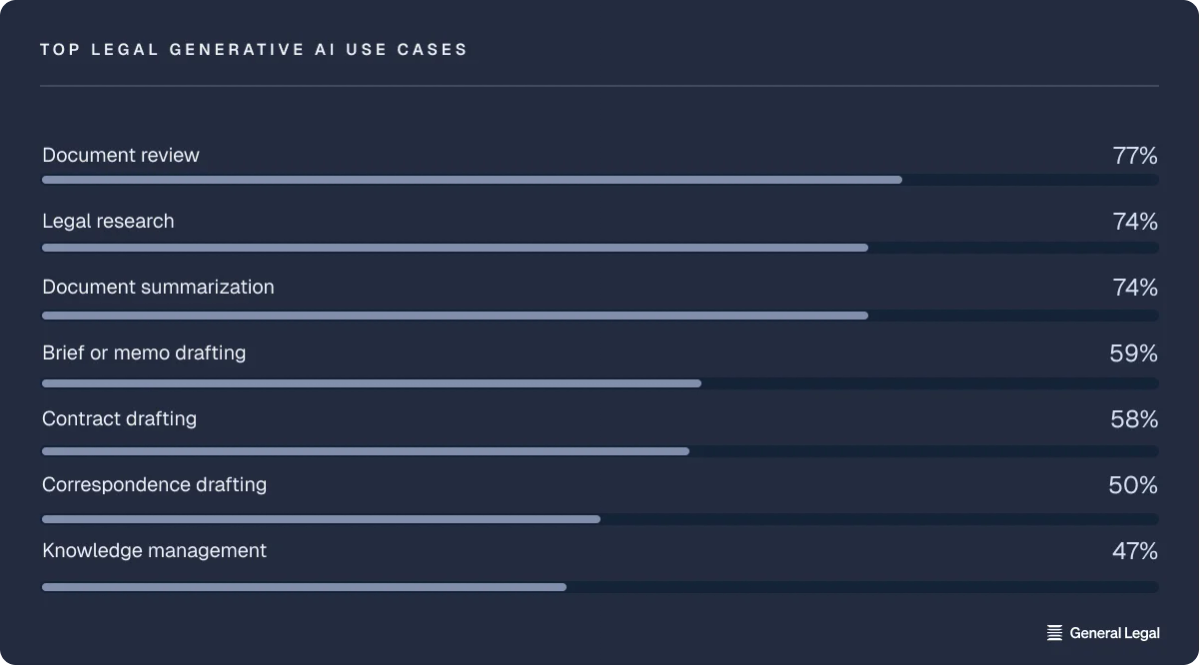
That’s because AI can search, retrieve, summarize, and cross-reference huge volumes of case law, statutes, regulations, and legal commentary in seconds. Instead of a lawyer spending hours digging through databases and stitching together relevant authorities, AI can surface the material, organize it, and give the lawyer a head start.
This development puts pressure on one of law’s oldest economic assumptions that more human hours means more value.
2. AI can handle high-volume document review at scale
Contract review is one of the most common—and potentially expensive—aspects of legal work.
ContractsCounsel’s marketplace data puts the average contract review cost at around $600, but sophisticated transactions can push costs as high as $20,000.
Now, AI is coming for one of lawyers’ biggest sources of billable work.
AI can work through large volumes of contracts, emails, and case documents, flagging unusual clauses, missing provisions, inconsistencies, privileged material, and potential risks far faster than a human reviewer working page by page.
This matters even more when the workload scales. A contract portfolio that would require a team of lawyers to review manually can be scanned by AI in a fraction of the time.
3. AI can draft routine legal documents
Not long ago, if you needed a contract, your first move was to call a lawyer. Today, AI can help you make a legal contract in minutes, without any professional help.
Besides contracts, generative AI can aid in producing other standardized documents, such as:
- Motions
- Discovery requests
- Legal memos
- Briefs
This capability changes the equation for businesses. If AI can take a few instructions and turn them into a reasonably sophisticated legal document, the need to hire a lawyer for every routine document starts to look a lot less obvious.
4. AI can spot patterns in cases and predict outcomes
Lawyers have always looked to past cases for clues about what might happen next. AI can take that idea and run it across a much larger dataset.
Specialized legal AI can analyze previous court decisions, judicial opinions, court records, and even a particular judge’s history to identify patterns that would be difficult for a human to spot manually. This can help estimate outcomes, such as:
- Whether a motion is likely to succeed
- How a judge tends to rule on certain issues
- Whether a case may be better suited for settlement
For a business, these capabilities can change how litigation decisions get made.
If AI can increasingly handle the pattern recognition and analysis that once required years of legal experience, some of the work traditionally reserved for senior lawyers can become software-assisted or potentially software-driven.
5. AI can make legal services significantly faster and cheaper
The strongest evidence that AI could make legal services cheaper is also the simplest: It’s already making legal work dramatically faster.
In one high-volume litigation use case, an AI-powered complaint response system cut associate time from 16 hours to just 3–4 minutes. As for the long-term results, Thomson Reuters’s 2025 Future of Professionals Report estimates that AI could free up approximately 240 hours per legal professional each year.
And the anecdotes are starting to sound just as wild as the statistics.
The lawyer from The Spectator’s piece tested an AI system on a complex civil appeal that had taken him a day and a half to write. After some prompting, the AI produced its version in 30 seconds, which he described as “spectacular” and “staggering,” and said was better than his own work.
These AI-powered legal workflows can help businesses get legal work done faster, handle more without adding headcount, and potentially pay less as fewer lawyer hours are needed to produce the same output.
6. AI could eventually move beyond routine tasks into complex legal work
Poor output quality is often cited as one of the key risks of AI in law. It’s one thing to have AI summarize a contract or produce a first draft; it’s another to trust it with a complicated legal strategy where the quality of the reasoning can make or break the outcome.
However, as AI keeps getting better at producing high-quality legal work, that boundary starts to disappear. Instead of just answering prompts, future AI systems could:
- Research an issue
- Build an argument
- Draft the necessary documents
- Check the relevant authorities
- Revise their work with limited human intervention
Such an improvement would push AI far beyond the work it handles today. This possibility is what makes the case for AI taking over law compelling. But the closer you look at what legal work actually requires, the harder that conclusion becomes.
Will AI take over law? 6 reasons it probably won’t
There are undoubtedly many benefits of using AI in law. However, getting a quick answer isn’t the same as practicing law.
These six reasons explain why the human layer isn’t going away anytime soon.
1. AI can’t replace human judgment
AI can automate pieces of legal work, but it still can’t take a legal matter from problem to decision to outcome without meaningful human judgment.
This distinction matters because law rarely operates like a simple question-and-answer system. The relevant statute might be clear, but the facts may not be, and a client may have several legally defensible options.
A lawyer has to decide what those trade-offs mean in the real world. This can involve:
- Assessing credibility
- Weighing competing interpretations
- Deciding how aggressively to pursue a claim
- Judging how a particular argument is likely to land
- Determining whether the legally available option is actually the right move for the client
These decisions depend on context, experience, strategy, and an understanding of the human stakes—not just the ability to find patterns in legal data. That’s what makes end-to-end automation of legal work virtually impossible.
2. AI can’t understand clients and their objectives
Clients rarely walk into a lawyer’s office with a perfectly defined legal question. Instead, they bring a problem.
A business owner might say they want to sue a supplier when what they actually need is leverage to renegotiate a contract. A founder might ask whether a fundraising deal is legally permissible when the real question is whether the risk is worth taking.
A lawyer’s job is to figure out what the client is actually trying to achieve.
That requires asking the right questions, understanding priorities, managing expectations, and translating a range of legal options into a practical recommendation. The final decision usually depends on understanding the person or business behind the legal problem, which is something AI can’t replicate through legal analysis alone.
3. AI can produce low-quality or incorrect work
AI can misinterpret legal language, invent case law, rely on outdated authorities, and produce arguments that sound convincing but are legally wrong.
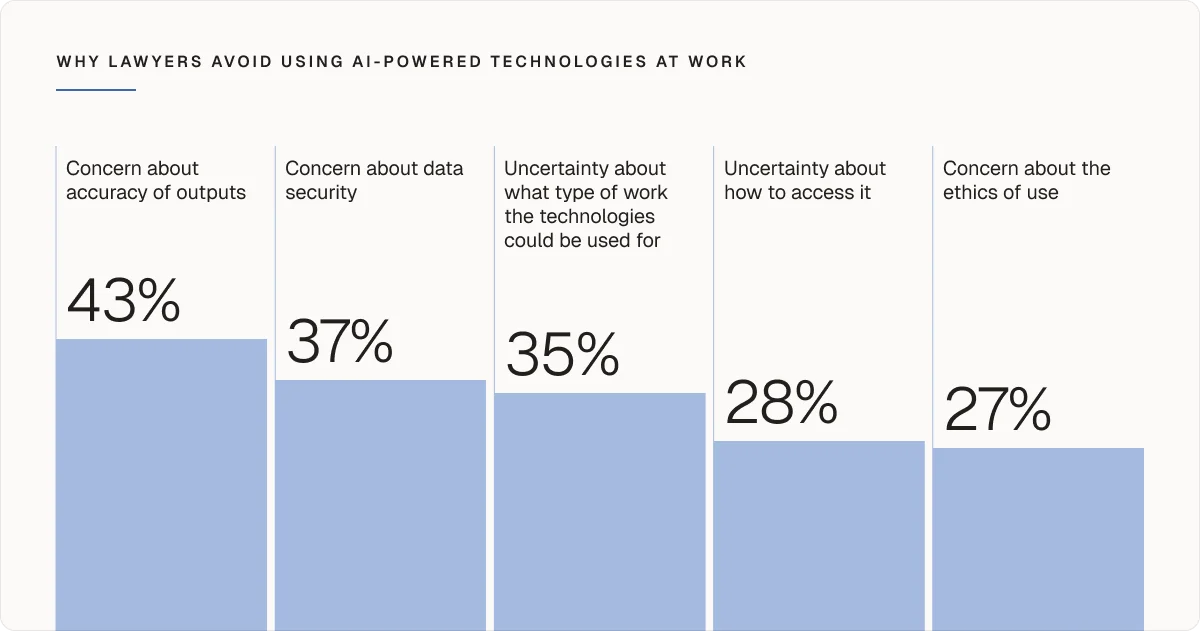
The problem is serious enough that 43% of legal professionals cited concern about output accuracy as a barrier to AI adoption in the 2024 Future of Professionals Report.
There is also a growing record of these failures. As of late September 2026, Charlotin’s public database has tracked 1,428 legal decisions involving hallucinated AI-generated content, most commonly fabricated citations.
The consequences of relying on these outputs can be severe.
In Mata v. Avianca, lawyers submitted fabricated cases generated by ChatGPT and were fined $5,000 each. In Gauthier v. Goodyear, an attorney using Claude submitted non-existent cases and fabricated quotations and was sanctioned by the court.
That’s why AI can’t safely handle legal work on its own. A lawyer has to verify the authorities, test the reasoning, catch missing context, and decide whether the output actually holds up under the law.
4. AI can’t replace human advocacy in court
Courtroom advocacy requires far more than producing a legally sound argument. Lawyers have to:
- Examine witnesses
- Respond to opposing counsel
- Persuade judges and juries
- Negotiate under pressure
- Adjust their strategy when the facts or the room changes
You can’t script a courtroom like a legal database.
That’s because a witness can give an unexpected answer, a judge might interrupt with a question, or the opposing counsel may change their argument. A human advocate has to read those signals and respond in real time.
AI is not considered capable of that role. As many as 96% of legal professionals say allowing AI to represent clients in court would be “a step too far,” while 83% consider AI providing legal advice an inappropriate use case.
5. AI can’t take legal responsibility
You can automate legal work, but you can’t automate legal accountability. This creates a fundamental problem with fully autonomous legal AI.
Lawyers have duties of competence, confidentiality, candor, and supervision. They are expected to verify their work and take responsibility for what they submit or advise, even when AI helped produce it.
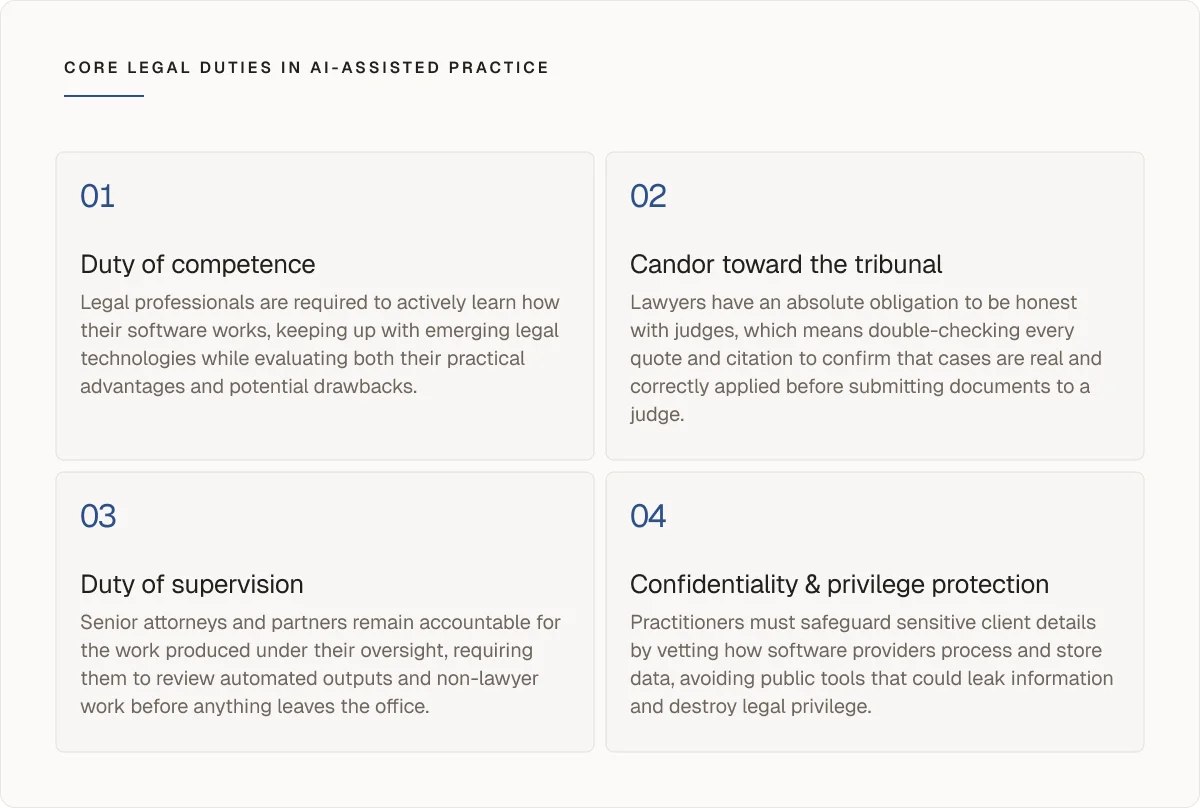
So, if an AI system gives incorrect advice, misses a critical legal issue, or produces a defective filing, the client still needs a qualified professional who can answer for that outcome.
6. The legal system may not allow AI to replace lawyers
The economics of using AI in corporate law could put pressure on the legal profession. If AI can handle more legal work at a fraction of the cost, companies will have an obvious incentive to push for wider use and fewer restrictions.
However, legal services can directly affect people’s rights and financial interests, and the legal system needs someone who can be held professionally accountable when things go wrong.
In fact, bar associations are already responding to the increased use of AI in the legal industry by applying existing duties around competence, confidentiality, diligence, and independent judgment to AI use.
With all this in mind, the biggest question is what happens when you put all of these capabilities and limitations together.
Will AI take over law? The answer is more complicated than you think
The panic around AI taking over law isn’t coming from nowhere. AI is already doing work that once required junior lawyers, paralegals, and legal support teams, and the technology is improving quickly.
But the debate tends to collapse into two extreme positions.
On one side, you have the AI maximalists. They believe that if you give the technology enough data, enough computing power, and enough time, the lawyer will become an expensive human bottleneck.
On the other side, there are the hard skeptics. They see AI fabricate a case citation or misunderstand a legal question and conclude that the technology is fundamentally unreliable for serious legal work.
Neither extreme captures where legal work is actually heading.
The nuance here lies in the distinction between tasks, jobs, and professions. A profession can survive even when a large percentage of its individual tasks become automated. That’s why the more likely outcome is that AI will automate large parts of legal work without eliminating the legal profession altogether.
A new category of AI-native law firms is emerging around exactly this middle ground.
The future of law may be AI-native law firms
Instead of asking whether AI will replace lawyers, AI-native law firms are asking a more useful question: How much more can a good lawyer accomplish when AI handles the work that doesn’t require their input?
That’s what firms like General Legal aim to answer in practice.
General Legal combines highly qualified, US-barred attorneys with AI-native workflows designed to automate the routine and manual parts of legal work. The AI takes the first pass; the attorney reviews the underlying contract, evaluates the AI’s analysis, applies their own judgment, and delivers the final legal work.
The difference still shows up in economics.
General Legal can turn many commercial contracts around in hours rather than days or weeks, while offering flat-fee pricing instead of traditional hourly billing.

And this may be the most realistic path forward for the legal industry.
The technology gets drastically better, lawyers become significantly more productive, and clients get faster legal work without giving up the human accountability that makes legal advice something they can actually rely on.
General Legal is effectively betting that the future of law won’t be about choosing between lawyers and AI. It will be about building law firms using AI where the two work together from the ground up.
If that sounds like the kind of legal support your team needs, sign up online and start sending your legal work to General Legal immediately. If you have more questions, schedule a quick call with our team first.
- AI adoption in legal work has surged dramatically, with usage rates jumping from 19% in 2023 to 79% in 2025 according to industry reports.
- AI can automate legal research, document review, and routine drafting at significantly lower cost and faster speed than traditional methods, potentially reducing work that once took 16 hours to just 3–4 minutes.
- Human lawyers remain essential for judgment, client strategy, courtroom advocacy, and legal accountability—areas where AI cannot reliably operate independently.
- AI systems have produced fabricated case citations and incorrect legal analysis in over 1,400 tracked court decisions, demonstrating serious quality control issues.
- The most likely outcome is AI-native law firms that combine attorney expertise with AI-powered workflows rather than complete automation of legal services.
- Regulatory frameworks and professional responsibility rules will likely prevent full AI replacement of lawyers, as the legal system requires accountable professionals.
| Current AI adoption rates | 69% of legal professionals now use AI tools at work, up from 19% in 2023, showing rapid integration across the industry. |
|---|---|
| What AI handles well | Legal research, high-volume document review, routine drafting, and pattern analysis in case outcomes are increasingly automated. |
| AI's limitations | Human judgment, client understanding, courtroom advocacy, and legal accountability cannot be reliably automated or delegated to AI. |
| Quality and accuracy concerns | AI has produced fabricated citations in 1,428 tracked court decisions, with lawyers facing sanctions for submitting AI-generated incorrect content. |
| Economic impact | AI can reduce legal work time dramatically—one system cut associate time from 16 hours to 3–4 minutes—potentially lowering costs significantly. |
| Likely future model | AI-native law firms combining attorney expertise with automated workflows represent the middle ground between full automation and traditional practice. |
| Professional resistance | 96% of legal professionals oppose AI representing clients in court, and bar associations are applying existing professional duties to AI use. |
| What changes for businesses | Companies can access faster legal services with flat-fee pricing as AI handles routine tasks while lawyers focus on judgment and strategy. |
Is AI going to replace law?
No. It’s more likely to automate large parts of legal work than replace the legal profession entirely. Lawyers will still be needed for judgment, strategy, advocacy, and accountability.
Is AI the biggest threat to BigLaw?
Possibly. AI could put significant pressure on BigLaw’s traditional model by reducing the time and headcount required for routine legal work.
What is the future of AI for lawyers?
AI will handle more research, drafting, analysis, and administrative work while lawyers focus on judgment, strategy, and client advice.
What career will not survive AI?
AI is less likely to wipe out entire job titles overnight and more likely to eliminate specific, repetitive tasks. However, roles built entirely around processing digital data, basic text, or routine administrative steps face the highest risk of disappearing in their current form.
- How Long Does It Take to Hire a Lawyer? [Full Breakdown]Learn how you can hire a lawyer faster, avoid lengthy intake processes, compare legal options, and get the support your business needs.
- The Neofirm: Why I Bet a Summer on AI-native Legal ServicesA glimpse of the future of AI-native law
- 7 Leading Contract Automation Tools for Legal Teams in 2026Discover leading contract automation tools for legal teams so you can compare features, workflows & solutions that fit your needs.