
Legora and Harvey are AI legal platforms that help law firms and in-house legal teams automate contract review, legal research, drafting, and other legal workflows. They’re also the two companies at the center of legal tech’s most closely watched rivalry, with Harvey recently reaching an $11-billion valuation and Legora following behind at approximately $5.55 billion.
Both pitch AI as a force multiplier for legal teams, deep integration into existing workflows, and a future where lawyers spend less time on low-value work. Also, both have convinced some of the biggest names in the legal industry to buy in.
With the two platforms seemingly having more similarities than differences, the question becomes: How do you choose between them?
This Legora vs. Harvey guide answers that question by evaluating both platforms individually before comparing them across the features, workflows, and user experience considerations.
Legora vs. Harvey at a glance
| Legora | Harvey | |
|---|---|---|
| Legal research | Strong international coverage across multiple jurisdictions | Strong US-focused research, including LexisNexis integration |
| Document analysis | Structured spreadsheet-style review with Tabular Review | Large-scale analysis through Vault and centralized document repositories |
| Integrations | Workflow-native integrations with Word, Outlook, DMSs, and legal research tools | Deep Microsoft 365 and enterprise ecosystem integrations |
| Knowledge management | Workflow and precedent-driven knowledge reuse | Firm-wide knowledge repositories and AI-powered retrieval |
| Client collaboration | Branded client portals and firm-powered workflows | Shared workspaces for firms, clients, and external collaborators |
| User experience | Faster, simpler, and easier to adopt | More comprehensive, but heavier and more enterprise-oriented |
| Implementation | Easier to deploy within existing workflows | Typically requires a broader platform rollout |
| Pricing transparency | No public pricing | No public pricing |
| Ideal users and use cases | Cross-border legal work and multilingual teams | Complex matters, litigation, and large-scale diligence |
Legora overview

Legora is an AI legal platform founded in Stockholm in 2023. Originally launched as Leya before rebranding in 2026, the company has quickly become one of the fastest-growing players in legal tech, currently serving more than 800 law firms.
The platform helps legal teams integrate AI into their day-to-day work, with a particular focus on enterprise adoption, multilingual environments, and complex legal operations. Its client roster includes a number of legal heavyweights, including White & Case, Linklaters, Goodwin, Bird & Bird, Cleary Gottlieb, and Dentons.
Core features
- Bulk document review: Analyze thousands of contracts, diligence files, or evidence documents in a spreadsheet-style interface that extracts answers, compares clauses, and surfaces patterns across large document sets.
- Multi-jurisdiction legal research: Research case law, statutes, regulations, and firm knowledge across multiple jurisdictions from a single interface.
- Document drafting and review: Draft, review, redline, translate, and automate document work directly within Microsoft Word.
- Workflow automation: Standardize recurring legal processes using reusable workflows grounded in firm precedents, playbooks, and institutional knowledge.
- Regulatory and document monitoring: Track legal, regulatory, or document changes over time and receive updates when relevant information changes.
- Client collaboration portal: Deliver AI-powered workflows, documents, and knowledge through a branded client-facing workspace while keeping the firm’s IP protected.
- Email workflow integration: Access AI assistance and complete legal tasks directly from Outlook without switching between platforms.
Pros
- Strong multilingual and cross-border capabilities
- Enterprise-grade security and compliance credentials
- Deep alignment with existing legal technology stacks
- Strong adoption among leading global law firms
- Flexible model-agnostic architecture
- Structured approach to high-volume legal operations
- Collaborative design built for team-wide adoption
Cons
- Limited pricing transparency during procurement
- BigLaw-centric product philosophy
- Extensive implementation and change-management requirements
- Significant vendor lock-in risk for enterprise customers
- Potentially excessive for smaller legal teams
Pricing
Legora doesn’t publish its pricing, making it difficult to pin down exact costs. Third-party reports place pricing anywhere from $2,400 to $8,000 per user annually, with pilot programs reportedly exceeding $150,000.
When informed estimates vary that widely, it usually means that pricing is negotiated deal by deal.
Harvey overview
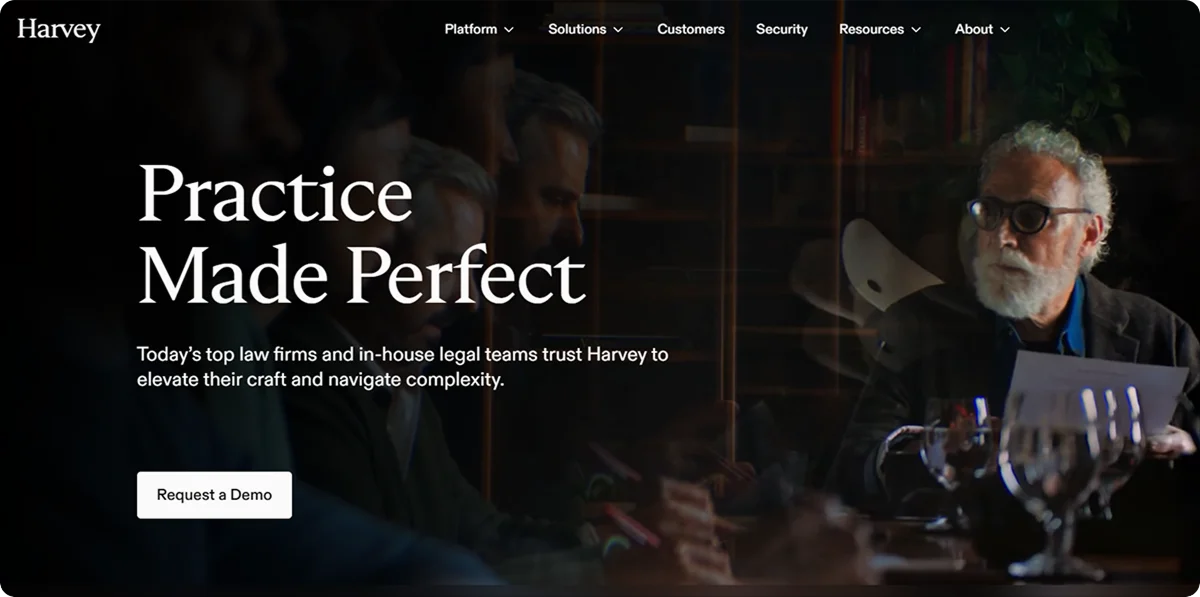
Harvey is an AI legal platform founded in 2022 by former litigator Winston Weinberg and AI researcher Gabriel Pereyra. Geared primarily toward large law firms and enterprise legal teams, the platform is designed to help lawyers manage complex legal work at scale.
Its customer base includes many of the world’s leading law firms and professional services organizations, including A&O Shearman, Latham & Watkins, Paul, Weiss, O’Melveny, PwC, and Bridgewater Associates.
Key features
- Bulk document analysis: Review, organize, and extract insights from large document collections, including due diligence files, litigation materials, and email correspondence.
- Legal research: Access legal databases, firm knowledge, and hundreds of legal content sources to answer questions, validate reasoning, and support legal analysis.
- Custom AI agents: Build workflow-specific AI agents using natural-language instructions and firm expertise to automate recurring legal tasks.
- Knowledge management: Ground AI outputs in firm templates, precedents, policies, and institutional knowledge for greater consistency and accuracy.
- Document drafting and review: Generate drafts, analyze legal documents, and refine work products from a single AI-powered workspace.
- Microsoft ecosystem integration: Work directly within Microsoft 365, including Word, Outlook, SharePoint, and Copilot, without switching between platforms.
- Large-scale document repositories: Store, organize, and query up to 100,000 documents within a centralized workspace designed for complex matters.
- Workflow automation: Create, deploy, and optimize multi-step legal workflows that can be reused across matters and practice groups.
Pros
- Strong adoption among Am Law and global law firms
- Deep focus on complex, high-stakes legal work
- Extensive legal content and research ecosystem
- Broad enterprise deployment across legal organizations
- Strong reputation within the legal AI market
- Mature Microsoft ecosystem integration
- Flexible approach to firm-wide AI adoption
Cons
- Limited upfront pricing visibility
- Enterprise-first product positioning
- Higher dependency on firm-wide implementation
- Potentially steeper learning curve
- Difficult-to-reverse platform adoption
- Less accessible to smaller legal teams
Pricing
Harvey doesn’t publish its pricing, and publicly available estimates vary dramatically.
Third-party reports place costs between roughly $500 and $2,400 per user per month ($6,000 to $28,800 per user annually), with enterprise contracts reportedly requiring annual commitments well into six figures.
Legora vs. Harvey: A detailed comparison
While Legora and Harvey share many of the same capabilities, meaningful differences emerge when you take a closer look at how each platform approaches legal work.
Bulk document analysis
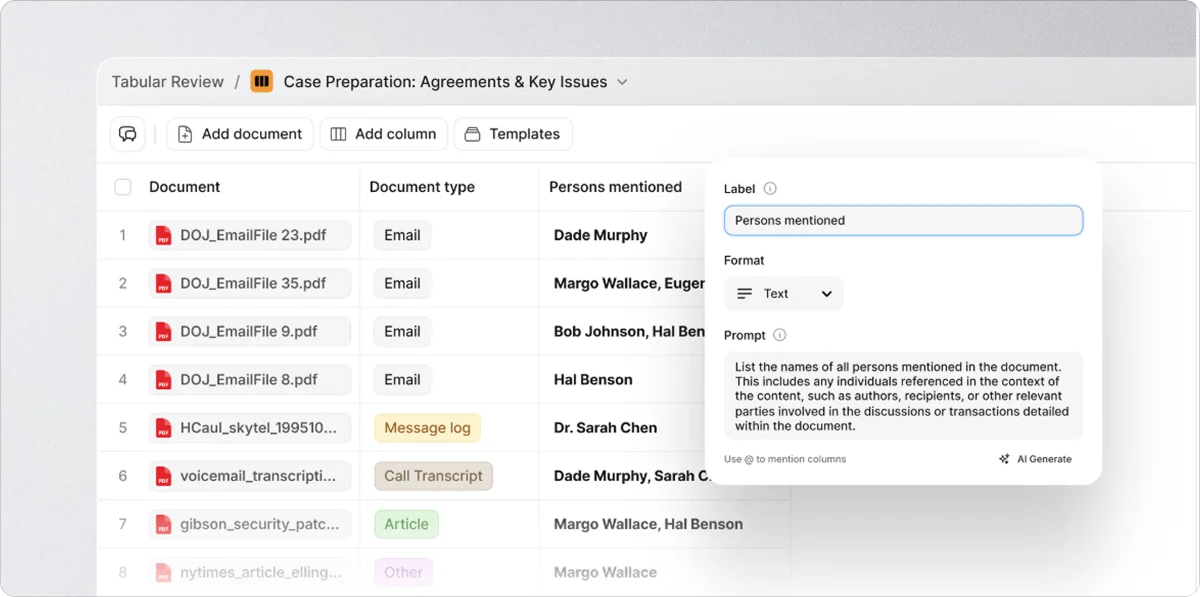
Legora approaches bulk document analysis through Tabular Review, which organizes documents into rows and prompts into columns, effectively turning large-scale review projects into an AI-powered spreadsheet. The experience is highly structured, making it easy to compare clauses, extract specific data points, and collaborate across large document sets.
One notable advantage is the ability to append multiple documents to a single row, giving reviewers additional flexibility when analyzing related materials.
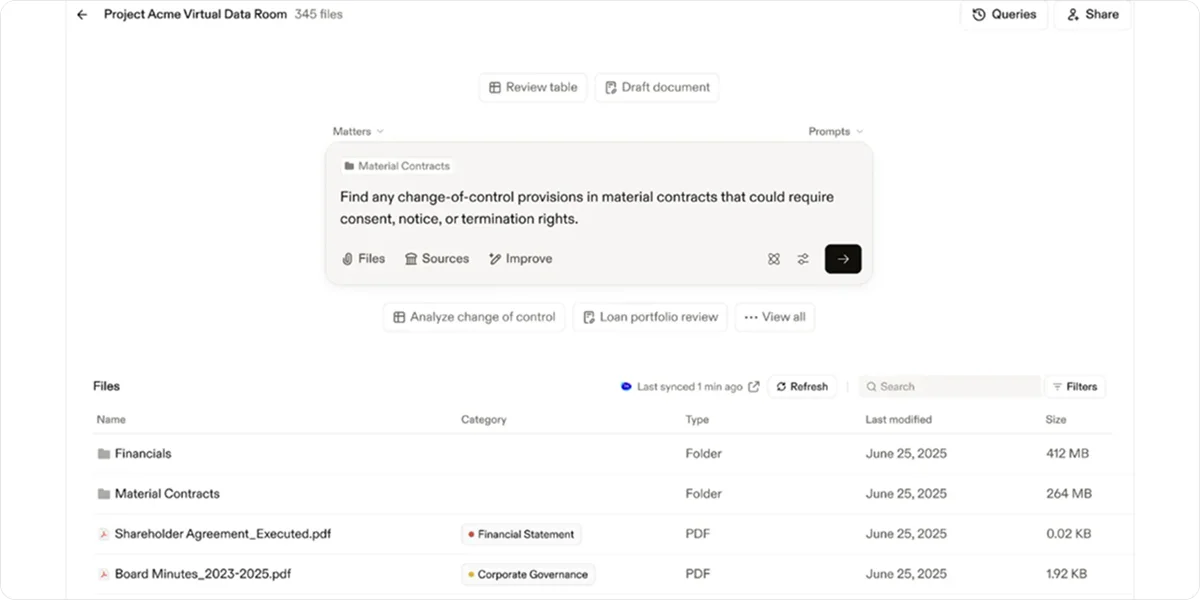
Harvey takes a slightly different approach with Vault.
Rather than emphasizing spreadsheet-style review, Vault is designed as a centralized repository for large document collections, allowing teams to store, organize, and analyze up to 100,000 documents from a single workspace. Harvey also combines review tables with broader matter-level analysis, making it particularly well-suited to large due diligence exercises, investigations, and litigation matters.
If your priority is highly structured review and comparison across document sets, Legora has a slight edge. If you’re dealing with massive document repositories and complex matters involving tens of thousands of files, Harvey’s Vault architecture is likely the stronger fit.
Legal research
Legora’s biggest strength is jurisdictional coverage.
The platform combines firm knowledge, web sources, and partnerships with authoritative legal databases across more than a dozen jurisdictions, giving lawyers access to case law, statutes, regulations, and other primary legal materials from around the world.
For firms handling cross-border matters, that breadth can be difficult to match.
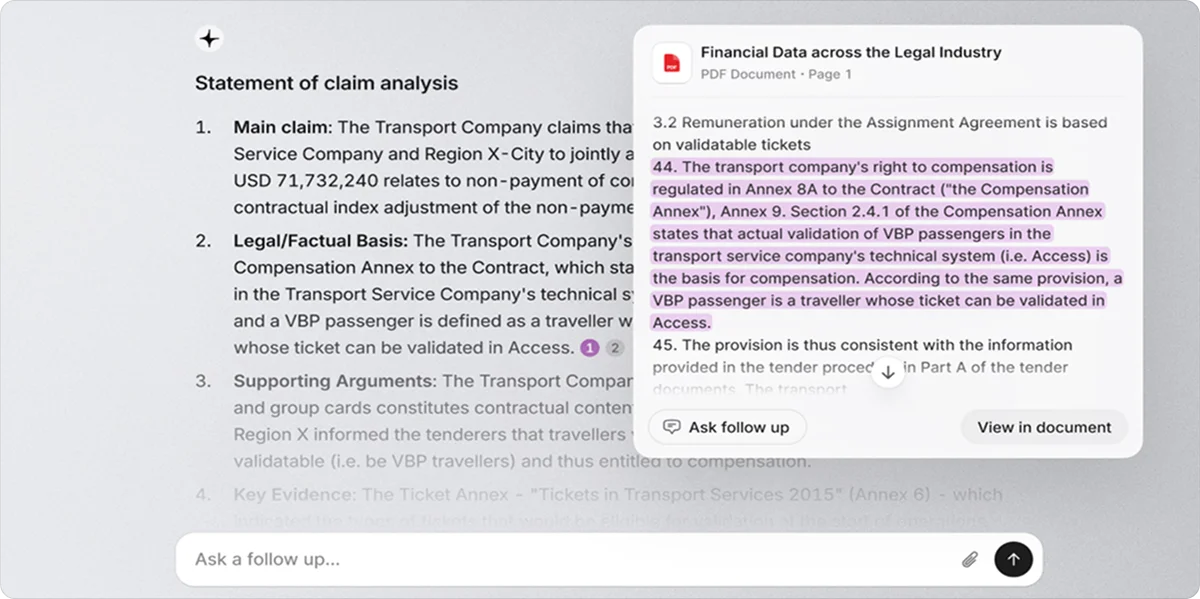
Harvey’s differentiator is its relationship with LexisNexis.
Users can query US case law, statutes, and regulations directly within Harvey, while also drawing on hundreds of additional legal and public data sources globally. The result is a research experience that feels particularly valuable for US legal teams already accustomed to working within the Lexis ecosystem.
Pro tip:
When evaluating legal research tools, look beyond the list of content providers. What matters is whether lawyers can move from question to answer without constantly switching between platforms, rerunning searches, or validating citations elsewhere.
Integrations
Legora’s integration strategy is built around existing workflows, aiming to keep lawyers in familiar environments while adding AI capabilities around them.
Its Outlook and Microsoft Word add-ins bring AI directly into the tools lawyers use every day, while integrations with document management systems, legal research providers, and other enterprise systems allow the platform to operate as part of the firm’s overall technology stack.
Harvey takes a broader enterprise platform approach.
In addition to Microsoft Word, the platform integrates with Microsoft 365 Copilot, document management systems like iManage and SharePoint, and a growing ecosystem of enterprise knowledge sources. Rather than sitting in the background, Harvey feels like a dedicated legal workspace designed to centralize research, drafting, knowledge management, and document analysis in a single environment.
Neither approach is inherently better.
Firms looking to layer AI onto existing processes may prefer Legora’s more workflow-native experience, while organizations willing to invest in a larger platform rollout may find Harvey’s deeper enterprise ecosystem more compelling.
Client-facing portal
Legora’s Portal is designed to help firms package and deliver their expertise.
Firms can create custom workflows grounded in internal precedents, databases, and playbooks, then make those workflows available to clients through a branded interface. Clients can upload files, query shared documents, and interact with firm-built tools without ever seeing the prompts, logic, or knowledge that powers them.
Harvey’s Shared Spaces is more collaborative in nature.
Instead of creating firm-powered solutions for clients, it brings law firms, clients, and internal teams into a single governed environment where everyone works from the same set of documents, knowledge, and context. Features like Shared Vaults, guest accounts, and usage analytics make it especially relevant for matters involving multiple stakeholders and ongoing collaboration.
The distinction is subtle but important.
Legora’s Portal feels closer to a client-facing product that happens to be powered by a law firm; Harvey’s Shared Spaces feels more like a shared legal workspace that happens to include clients.
User experience
Legora emphasizes speed and simplicity. The platform is organized around distinct legal workflows, making it easy to move between research, drafting, document review, and client-facing work. As a result, new users can typically become productive quickly without spending much time getting used to the platform.
Harvey offers a wider set of capabilities, but the additional functionality can create a more complex experience.
For this reason, teams looking for a streamlined experience will likely prefer Legora, whereas organizations seeking a more comprehensive legal AI platform may gravitate toward Harvey.
Which should you choose?
In many cases, the final decision between Legora and Harvey comes down to the overall fit for the type of legal work your team handles every day.
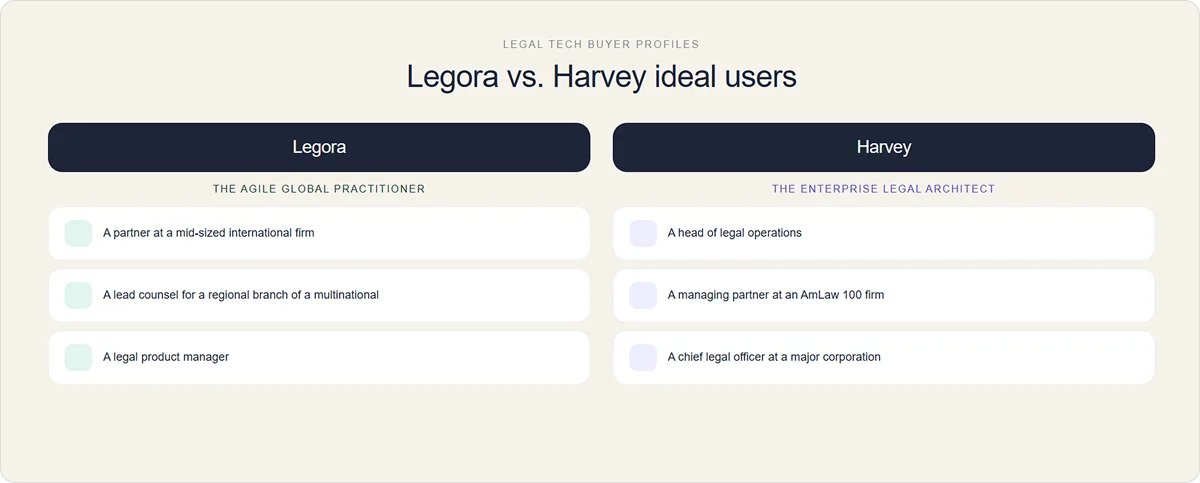
You should choose Legora if you:
- Need strong multilingual and cross-border legal research capabilities
- Regularly work across multiple jurisdictions
- Prioritize speed, simplicity, and ease of adoption
- Want a more streamlined day-to-day user experience
- Plan to build client-facing workflows and branded legal products
- Prefer AI that integrates directly into existing workflows
In contrast, Harvey might be a better fit if you:
- Handle large-scale diligence, investigations, or litigation matters
- Need to manage and analyze massive document repositories
- Rely heavily on US legal research and LexisNexis content
- Want a centralized legal AI platform for the entire organization
- Have dedicated legal operations, innovation, or knowledge management resources
- Are looking for maximum depth across complex legal workflows
However, as the legal AI market matures, a third option is becoming increasingly common in the Legora vs. Harvey debate: Neither platform works particularly well for your team’s needs.
The most common reasons legal teams reach this conclusion include:
- Enterprise pricing: Many legal teams struggle to justify six-figure pilots, opaque pricing, and lengthy sales cycles for tools that may only solve a handful of day-to-day problems.
- BigLaw-first design: Both platforms were built primarily for large law firms, which means their workflows, deployment models, and feature sets don’t always align with the needs of lean legal teams.
- AI commoditization: As GPT, Claude, and other foundation models continue to improve, some buyers are questioning how much differentiation exists between legal AI platforms.
- Uncertain long-term ROI: Over a three- to five-year period, software costs can quickly outpace the unique value the platform provides.
- Vendor lock-in: Once legal workflows, documents, and institutional knowledge are embedded in a platform, switching providers can become expensive and disruptive.
- Platform complexity: Some legal teams simply need better drafting, review, and knowledge management, not another enterprise system to implement, train, and manage.
These concerns are particularly relevant for startups and high-growth companies that need practical legal support, predictable costs, and fast implementation. But if neither platform is the answer for these companies, what is?
General Legal: A better alternative to Legora and Harvey for startups and high-growth companies
Faced with enterprise pricing and implementation complexity, many companies have considered cheaper and simpler alternatives to Harvey and Legora.
However, they quickly discover that legal work involves much more than drafting text or summarizing documents. Someone still needs to evaluate risk, understand commercial context, develop negotiation strategy, and make judgment calls when the answer isn’t obvious. AI can accelerate those tasks, but the quality of the outcome still depends on the lawyers involved.
Hiring a single in-house lawyer doesn’t fully solve the problem, either.
One attorney can only bring so much expertise to the table. As companies grow, legal questions quickly span commercial contracts, employment, privacy, corporate governance, fundraising, IP, and more. No single lawyer is an expert in all of them.
This is where the AI-native law firm model becomes the best alternative to software.
General Legal was built specifically around that model, combining experienced attorneys with AI-powered review, drafting, and operational workflows to deliver legal services faster, more predictably, and at a cost that makes sense for growth-stage companies.
Here’s what that looks like in practice:
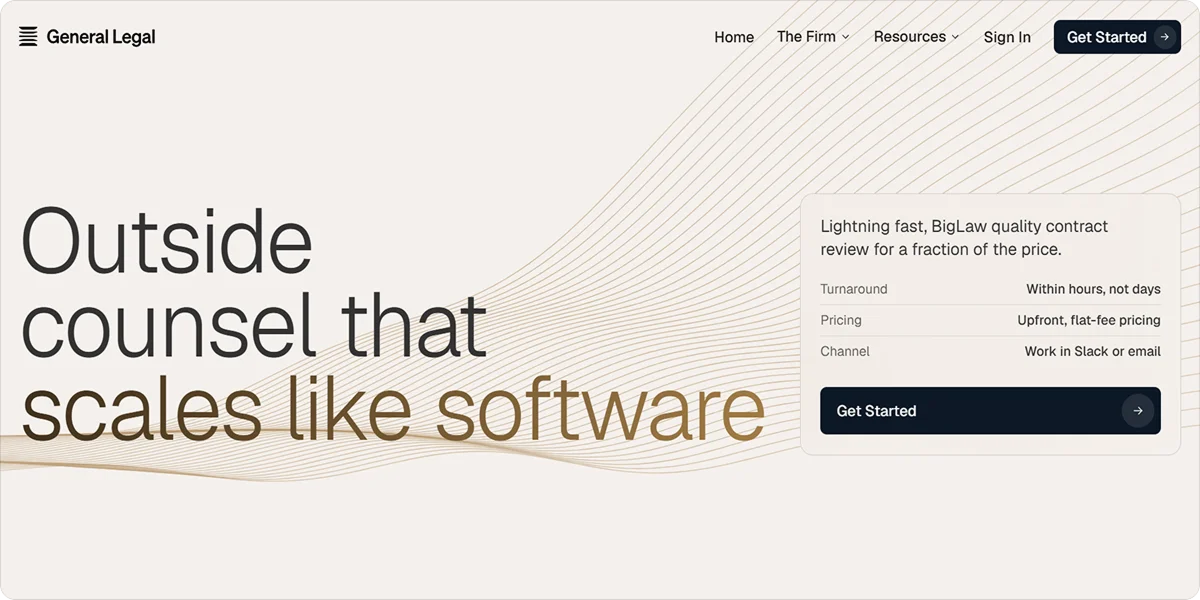
- Contract review in hours, not days: Harvey and Legora can accelerate contract review. General Legal removes it from your team’s to-do list entirely, delivering attorney-reviewed redlines and negotiation guidance in hours.
- Expertise across multiple practice areas: Instead of relying on a single in-house attorney, companies can tap into specialists across different areas as needed.
- Legal advice, not software output: AI can identify issues and suggest edits. General Legal attorneys determine which issues actually matter, how much leverage exists, and what strategy best serves the business.
- Slack-native collaboration: Rather than introducing another platform into the stack, most clients work directly with their lawyers through dedicated Slack channels where contracts, questions, and legal requests are handled in real time.
- Transparent, flat-fee pricing: There are no enterprise software contracts, seat minimums, pilot programs, or procurement cycles. Most commercial contract reviews are priced upfront and delivered at fixed fees.
If you’d rather spend your time closing deals than evaluating legal software, sign up for General Legal and start sending contracts immediately.
Have questions first? Reach out to our team directly, and we’ll help you decide whether the AI-native law firm model is the right fit for your business.
- Legora (valued around $5.55B) and Legora and Harvey (valued around $11B) are the two most closely watched rivals in legal AI, both automating contract review, research, and drafting for law firms and in-house teams.
- Legora's edge is cross-border work: strong multilingual and multi-jurisdiction research coverage and a faster, simpler user experience, serving 800+ firms including White & Case and Linklaters.
- Harvey's edge is scale: its Vault product can analyze up to 100,000 documents and it's used by 75+ Am Law 100 firms, making it stronger for large diligence, investigations, and litigation.
- Neither platform publishes pricing; third-party estimates place Legora around $2,400-$8,000 per user annually and Harvey around $6,000-$28,800 per user annually, both with six-figure enterprise commitments reported.
- Both platforms share common weaknesses for smaller teams: opaque enterprise pricing, BigLaw-first design, lengthy implementation, and vendor lock-in risk once workflows and knowledge are embedded.
- For startups and high-growth companies that find neither platform fits, General Legal is positioned as combining AI-native workflows with experienced attorneys who make judgment calls, delivered through Slack at flat fees with no procurement cycle.
| The rivalry | Legora (~$5.55B valuation) and Harvey (~$11B valuation) are legal AI's two most closely watched competitors, both automating research, drafting, and contract review. |
|---|---|
| Legora's strength | Cross-border legal work: strong multilingual, multi-jurisdiction research and a simpler, faster user experience, used by 800+ firms including White & Case and Linklaters. |
| Harvey's strength | Large-scale, complex matters: Vault can analyze up to 100,000 documents, and it's used by 75+ Am Law 100 firms plus a deep LexisNexis research integration. |
| Pricing | Neither publishes pricing; estimates put Legora at $2,400-$8,000/user/year and Harvey at $6,000-$28,800/user/year, both with reported six-figure enterprise deals. |
| Shared weaknesses | Both carry opaque pricing, BigLaw-first design, lengthy implementation, and vendor lock-in risk, making them a poor fit for lean legal teams. |
| Choosing between them | Choose Legora for cross-border work and simplicity; choose Harvey for large-scale diligence, litigation, and US-focused research via LexisNexis. |
| The third option | For startups and high-growth companies, General Legal offers AI-native workflows plus experienced attorneys handling judgment and negotiation, at flat fees with no enterprise procurement. |
Is Legora the same as Harvey?
No. Both offer AI-powered legal research, drafting, and document review, but they differ in research coverage, document analysis style, integrations, and overall user experience.
Are Harvey and Legora direct competitors?
Yes. They're two of the leading AI legal platforms, competing for many of the same law firm and in-house legal team customers.
Is Harvey better than Legora?
Not necessarily. Harvey tends to perform better on large-scale document analysis and complex matters, while Legora offers a faster experience and stronger multilingual capabilities; the better choice depends on the team's needs.
What firms use Legora?
Legora's client roster includes White & Case, Linklaters, Goodwin, Bird & Bird, Cleary Gottlieb, and Dentons.
Is there a single best AI software for lawyers?
No. The right choice depends on team size, type of legal work, budget, and existing workflows; for some companies the better solution may not be software at all, but an AI-native firm like General Legal.
Can AI replace human lawyers?
No. AI can automate research, drafting, document review, and other repetitive tasks, but legal advice, strategic judgment, negotiation, and risk assessment still require experienced lawyers.
Are Harvey and Legora competitors?
Yes. Harvey and Legora are two of the leading AI legal platforms, competing for many of the same law firm and in-house legal team customers.
What is the best AI software for lawyers?
There’s no single best AI software for lawyers. The right choice depends on the size of the legal team, the type of legal work being performed, budget constraints, and existing workflows. In some cases, the best solution may not be software at all. For startups and high-growth companies, AI-native law firms like General Legal can provide a more practical alternative by combining AI tools with experienced legal counsel.
- 7 Best Legora Alternatives for AI Legal Teams [Compared]Explore the best Legora alternatives so you can compare legal AI platforms, find the right fit & streamline your legal workflows.
- 6 Best Harvey Alternatives for Law Firms [2026 Comparison]Explore the best Harvey alternatives so you can compare legal AI tools by cost, features, workflows, and ease of adoption.
- 7 Leading Contract Automation Tools for Legal Teams in 2026Discover leading contract automation tools for legal teams so you can compare features, workflows & solutions that fit your needs.