
Indemnification clauses show up in most commercial contracts. They also routinely become a major point of negotiation between contracting parties.
According to the 2026 Most Negotiated Terms report by the Commerce & Contract Management Institute and Sirion, indemnification is one of the three most negotiated contract terms on both the buy and sell sides, alongside limitation of liability and price.
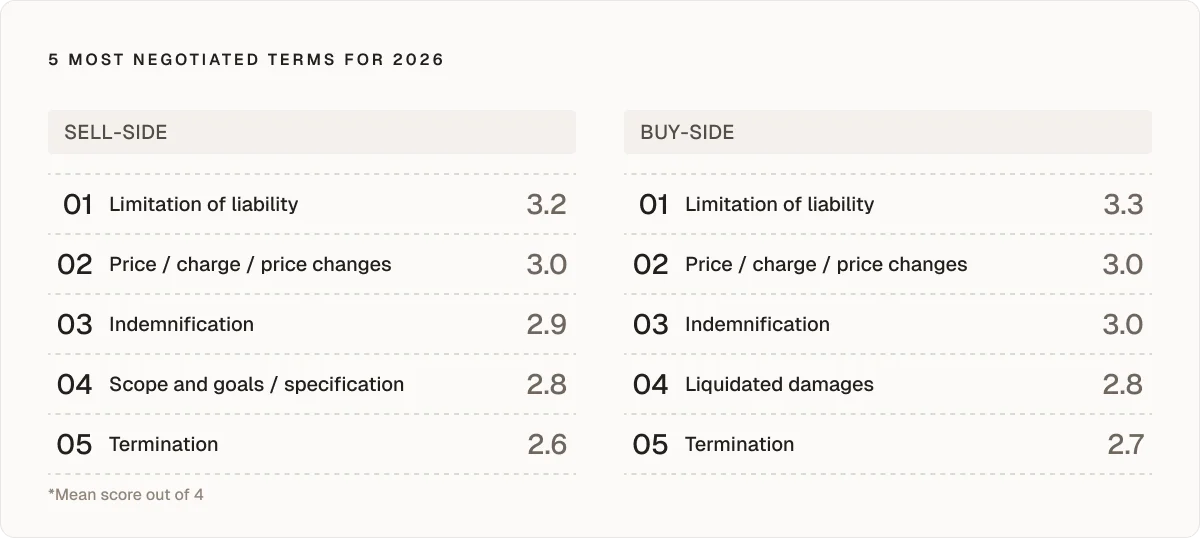
This isn’t a new trend: The report notes that indemnification has remained among the top three negotiation priorities for more than 20 years.
Given how frequently these provisions appear (and how much negotiating attention they attract), founders need to know what they’re agreeing to, which terms are reasonable, and where seemingly standard language can expose their company to disproportionate liability.
This guide breaks down what to look for, what to accept, and what to push back on when reviewing an indemnification clause.
What is an indemnification clause?
An indemnification clause is a contractual provision in which one party (the indemnifying party) agrees to cover specified losses, damages, liabilities, or legal expenses incurred by another party (the indemnified party) when certain events or claims occur.
What is indemnity, then? It’s the protection itself: The indemnified party’s right to be covered for those losses.
For example, if a SaaS company’s software allegedly infringes a third party’s intellectual property rights and a customer gets sued as a result, the company’s indemnification obligation may require it to cover the customer’s legal costs, damages, or settlement expenses, provided the claim falls within the clause’s scope.
This is an example of a third-party claim, which is a claim brought by someone outside the contract.
By contrast, a first-party claim arises directly between the contracting parties. For instance, if the SaaS company breaches the agreement and causes the customer financial losses, the customer may bring a claim directly against the company.
What is included in an indemnification clause?
An indemnification clause typically spells out several things:
Indemnification can be one-way (unilateral) or mutual.
- In a one-way clause, only one party agrees to indemnify the other.
- In a mutual clause, both parties take on indemnification obligations for specified claims or losses.
The mutual vs. one-way indemnity choice usually follows the risk: The party whose product, data, or conduct creates the exposure typically gives the broader indemnity.
When do founders encounter indemnification clauses?
Founders will encounter indemnification clauses in almost every significant commercial agreement their company signs. The wording and scope vary depending on the transaction, but the provisions typically appear in the following types of agreements:
- Customer and SaaS agreements: Enterprise customers, often through a master services agreement, may require SaaS providers to indemnify them against third-party IP infringement claims, while providers may seek protection against claims arising from customers’ misuse of the service.
- Vendor and supplier agreements: These agreements often allocate responsibility for losses caused by defective products, delivery failures, property damage, or a supplier’s breach of contractual obligations.
- Software development and licensing agreements: Indemnification provisions commonly address IP infringement, software defects, and claims arising from how licensed technology is used.
- Professional services and consulting agreements: These provisions may cover claims arising from professional negligence, errors and omissions, or failures to meet contractual obligations.
- Strategic partnership and joint venture agreements: When two companies collaborate, indemnification clauses help allocate responsibility for claims arising from each party’s actions, employees, or contractual obligations.
- Investment and financing agreements: Standard SAFEs generally don’t include indemnification provisions, but priced rounds and more complex financings often tie indemnities to the company’s representations and warranties.
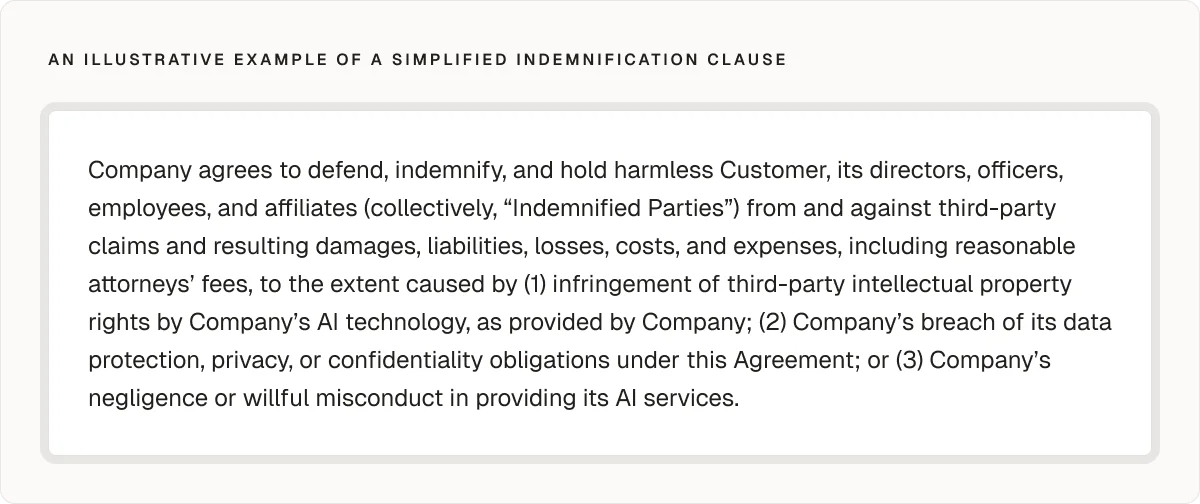
Because indemnification clauses are so common, founders need to know what a fair, well-drafted provision looks like.
What to accept in an indemnification clause
In most cases, the following provisions are reasonable to accept in an indemnification clause.
Disclaimer: These are general negotiating guidelines, not a substitute for legal advice. Whether a particular provision is acceptable depends on the specific agreement, applicable law, and the circumstances of the deal.
1. Accept indemnity for third-party claims caused by your breach or conduct
It’s reasonable to cover third-party claims arising from your company’s breach of specific contractual obligations, negligence, or actions under the agreement. This may include claims involving bodily injury, property damage, or the mishandling of customer data and confidential information.
2. Accept IP infringement indemnity for your own product or service
If your company develops software, licenses technology, or provides a product incorporating its own IP, customers can reasonably expect protection against third-party infringement claims. This IP indemnity is a standard way to stand behind the technology your company provides, and enterprise customers often expect it before they sign.
3. Accept indemnity for material breaches of specific representations and warranties
If your company makes specific representations or warranties in an agreement, it’s reasonable to cover losses resulting from materially false statements. The indemnity should, however, remain consistent with the qualifications and limitations attached to those representations and warranties.
4. Accept mutual indemnification when obligations are reciprocal
Mutual indemnification is reasonable when both parties can expose each other to comparable risks. For example, each party may agree to cover specified third-party claims arising from its own conduct or contractual breaches.
5. Accept reasonable caps on indemnification liability
An indemnification obligation doesn’t necessarily need to be unlimited. A cap, whether tied to the agreement’s general liability limit or set separately for particular risks, can keep potential exposure proportionate to the deal.
However, not every agreement offers this protection. Here’s what founders should push back on when negotiating an indemnification clause.
What to push back on in an indemnification clause
The 2026 Most Negotiated Terms report estimates that only 0.007% of contracts go to litigation. But while disputes are rare, the financial consequences can be significant when they do arise. Your indemnification clause can determine who bears those costs, so here are the red flags to watch for.
1. Push back on indemnification for first-party losses
Be cautious when a clause intended to cover third-party claims also extends to direct losses between the contracting parties.
This can turn an indemnity into a broader remedy for ordinary contract disputes, potentially exposing your company to costs beyond those covered by the agreement’s standard breach-of-contract provisions.
Courts in some states, including New York, read indemnity clauses as covering only third-party claims unless the contract clearly says otherwise, which is why the exact wording matters.
What to propose instead
Limit the indemnity to third-party claims. If the other party wants coverage for direct losses, define those losses separately and negotiate clear limits.
2. Push back on broad or vague indemnification triggers
Phrases like “any and all claims” or “related to the performance of this agreement” can sweep in claims that have little connection to your company’s actual conduct. The broader the trigger, the harder it may be to predict what your company could be required to cover and the greater the potential liability.
What to propose instead
Replace blanket language with specific covered events and a narrower causal connection, such as claims “caused by” or “resulting from” your company’s acts or omissions.
3. Push back on indemnifying the other party for its own negligence
An indemnity shouldn’t make your company responsible for losses caused by the other party’s own negligence, misuse, or misconduct. Otherwise, you could end up paying for an incident you didn’t cause, including damages arising from the other party’s failure to meet its own obligations.
What to propose instead
Add an express exclusion for claims or losses caused by the indemnified party’s negligence, gross negligence, willful misconduct, or improper use of your product. The enforceability of these exclusions and the treatment of indemnification for another party’s negligence vary by state, so the language should be checked against the governing law.
4. Push back on defense obligations without defense and settlement control
A duty to defend can require your company to pay legal fees as soon as a covered claim is brought, even before fault or liability has been established.
Without a corresponding right to control the defense, you may be funding lawyers and litigation strategies chosen by the other party, with little control over how much the dispute costs.
What to propose instead
Seek the right to select counsel and control the defense when you’re paying for it, subject to reasonable protections for the indemnified party. You can also negotiate rights to participate in the defense and consent to settlements that impose obligations or admissions on your company.
5. Push back on disproportionate indemnification caps
An indemnity with no financial cap can leave your company exposed to potentially unlimited liability. However, a cap set too low may also be problematic if it fails to reflect the risks being covered.
Watch for language that excludes indemnification from the agreement’s general liability cap without providing a reasonable alternative.
What to propose instead
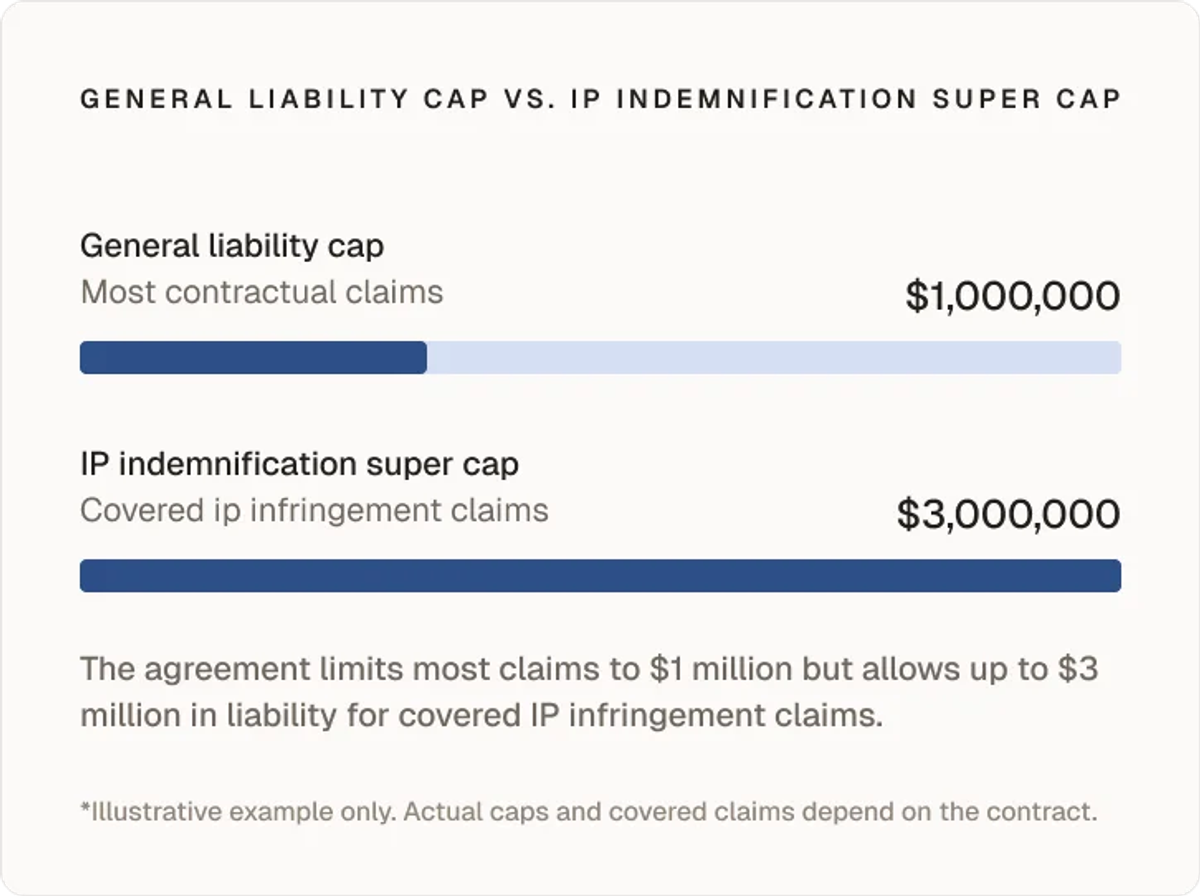
Negotiate for indemnification to fall within the main liability cap or, where the risk justifies it, agree on a separate, higher “super cap.” Make sure the limit applies to aggregate liability, not just individual claims, and that other contract provisions don’t undermine it.
6. Push back on indefinite indemnification periods
An indemnification obligation that survives indefinitely can leave your company exposed to claims long after the commercial relationship has ended. This uncertainty can complicate financial planning and make it difficult to determine when your contractual risk has actually expired.
What to propose instead
Set a defined survival period that gives the other party a reasonable opportunity to bring covered claims while putting a clear endpoint on your company’s obligations. The period should account for the types of claims covered and any applicable statutes of limitations.
7. Push back on notice requirements that automatically forfeit coverage
A clause that eliminates indemnification rights for any delay in giving notice can be unnecessarily harsh, particularly when the delay hasn’t affected the indemnifying party’s ability to defend the claim. Your company could lose protection over a procedural mistake rather than the merits of the underlying claim.
What to propose instead
Provide that late notice only reduces or relieves the indemnifying party’s obligations to the extent the delay materially prejudices its ability to respond to or defend the claim.
8. Push back on liability for customer misuse or unauthorized modifications
If a customer modifies your software, combines it with incompatible products, or uses it contrary to your documentation or terms, your company shouldn’t automatically bear responsibility for resulting claims.
Otherwise, you could face indemnification costs for problems caused by the customer’s own decisions.
What to propose instead
Include exclusions for claims arising from unauthorized modifications, combinations with products or software not approved by your company, or use outside the agreed specifications or permitted purposes.
Even with these guidelines and a contract review checklist, it can be difficult to know where to push back and when a proposed compromise creates more risk than it solves, especially if you haven’t negotiated commercial contracts before.
That’s where legal help pays off, and it doesn’t have to mean hiring a traditional law firm, waiting weeks for a redline, or agreeing to unpredictable hourly fees. Instead, you can work with an AI-native law firm like General Legal.
Why negotiate indemnification with General Legal
General Legal’s US-barred attorneys can help protect your business by using AI-powered workflows to review commercial contracts, identify problematic language, and provide practical redlines and negotiation guidance.
This means General Legal isn’t a contract-review AI tool that leaves you to interpret the results yourself.
Its experienced attorneys use AI-powered workflows to speed up the work and leverage automation, so you can get a median first turn of three hours or less on commercial work.
If you need more than an initial review, General Legal can also handle the negotiation with the other party.
You can work directly with your attorney over Slack, email, or the client portal, without the usual billable-hour surprises. Instead, General Legal delivers high-quality legal work at predictable, upfront flat fees.
To learn more about how our attorneys can help you with negotiating your indemnification clause and other commercial contracts, book a quick call. If you’re ready to get started, create your account to open a matter.
- Indemnification ranks among the three most negotiated contract terms, alongside limitation of liability and price, and has held that spot for more than 20 years.
- An indemnification clause makes one party cover specified losses, damages, or legal costs of the other, and it can be one-way or mutual depending on who creates the risk.
- Reasonable terms to accept include indemnity for third-party claims caused by your own breach or conduct, IP infringement protection for your own product, and sensible liability caps.
- Terms to push back on include coverage of first-party losses, vague triggers like “any and all claims,” and indemnifying the other side for its own negligence.
- Founders should also resist defense duties without control of the defense, indefinite survival periods, and notice rules that forfeit coverage over a late notice.
- Because enforceability varies by state and by deal, founders should have an attorney review proposed language rather than relying on general guidelines alone.
| What it is | A clause where one party agrees to cover specified losses, damages, or legal costs of the other when certain claims arise. |
|---|---|
| Claim types | Third-party claims come from outside the contract; first-party claims arise directly between the contracting parties. |
| Where it appears | Customer and SaaS agreements, vendor deals, software licensing, consulting, partnerships, and priced financing rounds. |
| What to accept | Third-party claims tied to your conduct, IP indemnity for your own product, indemnity for material breaches of specific reps and warranties, mutual indemnity when risks are reciprocal, and reasonable caps. |
| Scope red flags | First-party loss coverage, vague triggers, and indemnifying the other party’s own negligence. Narrow these with specific covered events and “caused by” language. |
| Process red flags | Defense duties without control of defense and settlement, and notice rules that forfeit coverage for any delay. |
| Cap and time red flags | Uncapped or badly sized liability and indefinite survival periods. Seek a main cap or “super cap” and a defined end date. |
| Customer misuse | Exclude claims from unauthorized modifications, unapproved combinations, or use outside agreed specifications. |
What is indemnification in simple terms?
Indemnity, or indemnification, is a promise by one party to cover another party’s losses from specified claims or events. If a covered problem occurs, the indemnifying party pays the resulting costs.
What happens if there is no indemnification clause?
The parties lose the specific contractual protection provided by an indemnity. However, they may still have other legal remedies, such as breach-of-contract claims.
Are indemnification clauses enforceable?
Generally, yes. However, enforceability depends on applicable state law, the clause’s wording, and the circumstances. For example, some courts may refuse to enforce broad indemnification clauses that require one party to cover losses caused by the other party’s own negligence or misconduct.
Are indemnification and hold harmless the same thing?
Not necessarily. The terms are often used together, but some jurisdictions distinguish between indemnifying a party for losses and holding it harmless from liability.
Is an indemnification clause the same as a limitation of liability clause?
No. Indemnification determines which losses a party must cover; limitation of liability sets limits on its financial exposure.
- Legal Contract Requirements: 8 Clauses for BusinessesExplore legal contract requirements so you can understand what makes agreements enforceable, identify key clauses, & protect your business from risks.
- Contract Review Checklist: 5 Passes to Run Before You SignExplore how to review contracts before signing, identify hidden risks, protect your business interests, and negotiate safer terms with confidence.
- 6 Best Outside General Counsel Law Firms [Comparison]Explore the best outside general counsel law firms so you can compare legal support, expertise, pricing & fit for your business.