
According to the Commerce & Contract Management Institute’s 2025 benchmark report, an estimated 70–80% of organizations are believed to lack true accountability for the quality and integrity of their contracting and commercial processes.
Getting contracts right starts with something more basic: understanding what actually creates a legally binding obligation.
While founders commonly use the words “agreement” and “contract” interchangeably, they’re not quite the same. Every contract is an agreement, but not every agreement is an enforceable contract. Getting that distinction wrong can leave your business exposed to obligations you never intended to take on, or without the legal protection you thought you had.
This contract vs. agreement guide breaks down what each term means under US law, how the two differ in practice, and how to turn an agreement into an enforceable contract.
Contract vs. agreement: Legal definitions
Under Section 3 of the Restatement of the Law Second, Contracts, an agreement is “a manifestation of mutual assent on the part of two or more persons.” The parties can show that assent through words or conduct and, in limited circumstances, through silence, such as when past dealings make it a reasonable sign of acceptance.
In simpler terms, an agreement forms when one party proposes a set of terms, and another accepts them.
This understanding can be as straightforward as a founder agreeing with a freelancer on the scope of a project or as detailed as a written document outlining the terms of a potential business collaboration.
For startups, agreements are a practical way to establish expectations before, during, and throughout a business relationship. Common examples include:
- Letter of intent (LOI): Preliminary terms and intentions for a proposed transaction
- Memorandum of understanding (MOU): A shared understanding of a proposed collaboration
- Nonbinding term sheet: Preliminary business and economic terms of a proposed deal
Important: These labels don’t determine enforceability. Courts look at the document’s terms rather than its title, so an LOI, MOU, or term sheet can contain binding provisions or create enforceable obligations, depending on its wording and applicable law.
A contract is also an agreement between two or more parties, but one that creates mutual obligations enforceable by law.
Under Section 1 of the Restatement of the Law Second, Contracts, a contract exists when a promise or set of promises has legal effect, meaning the law recognizes an obligation to perform or provides a remedy for nonperformance.
Common types of contracts used by startups include:
- Master services agreement (MSA): General terms governing an ongoing services relationship
- Non-disclosure agreement (NDA): Confidentiality and restrictions on disclosing sensitive information
- Independent contractor agreement: Services, compensation, deliverables, and intellectual property rights
- Intellectual property assignment agreement: Transfer of ownership of intellectual property
Both agreements and contracts establish a shared understanding between parties. They can document business expectations, set out promises, and cover arrangements ranging from a simple exchange of services to complex commercial transactions.
Then, what separates an agreement from a contract?
Contract vs. agreement: 7 key differences
These seven differences help clarify the legal distinction between agreements and contracts and explain how each applies to business relationships.
1. How broad their legal scope is
An agreement is a broad term covering any mutual understanding, from an informal promise between founders to a preliminary term sheet.
A contract is a narrower, specific type of agreement that meets the legal requirements for formation and creates enforceable rights and obligations.
2. How formal they need to be
Agreements are generally more informal and flexible. They can arise from a casual conversation, a handshake, an exchange of emails, or conduct that demonstrates mutual assent (actions showing the parties agree to the proposed terms).
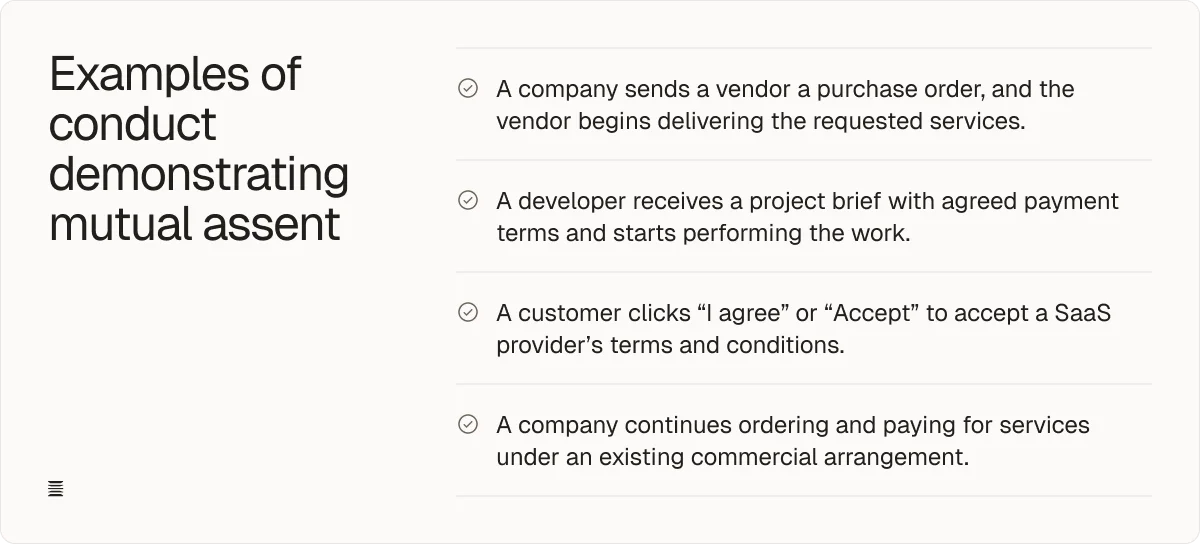
Contracts, on the other hand, are typically more structured and detailed. They clearly define each party’s rights, responsibilities, and performance requirements, and are designed to create legally enforceable obligations.
While not all contracts have to be signed, certain transactions are subject to these formalities, too.
For example, the Statute of Frauds requires certain contracts, including many agreements for the sale of real estate, to be evidenced by a signed writing.
Under Section 2-201 of the Uniform Commercial Code (UCC), contracts for the sale of goods priced at $500 or more generally require a signed writing to be enforceable, subject to exceptions.
3. How legally binding they are
An agreement doesn’t automatically create legally enforceable obligations. Its enforceability depends on the parties’ intentions, the terms of the arrangement, and compliance with the applicable legal requirements for contract formation.
A contract, by definition, creates legal rights and obligations that the parties can enforce in court. However, to do that, it must contain the following legal requirements:
- Offer and acceptance: One party proposes terms, and the other accepts them.
- Consideration: Each party gives or promises something of legal value.
- Capacity: The parties must have the legal ability to enter into the contract.
- Legality: The contract must have a lawful purpose.
- Definite terms: The essential terms must be sufficiently clear for a court to enforce.
4. How much legal protection they provide
A nonbinding agreement can help parties establish expectations and document their intentions, but it generally doesn’t provide the same legal protections as an enforceable contract.
A contract can protect a startup’s interests by:
- Clearly allocating responsibilities
- Defining performance requirements
- Establishing what happens if either party fails to deliver
Depending on the transaction, it can also address payment terms, intellectual property ownership, confidentiality, liability, termination, and dispute resolution.
Read more: What Should Be Included in a Commercial Contract
Important: Not every contract offers the same level of protection. Its effectiveness depends on how well its terms address the risks of the transaction. While you can draft a contract without a lawyer, having experienced counsel review it can help identify gaps and limit your liability.
5. What happens when someone breaks their promises
The consequences depend largely on whether the arrangement creates enforceable contractual obligations. If a party breaches a valid contract without legal excuse, the other party may pursue legal remedies. These can include:
If an arrangement isn’t an enforceable contract, contractual remedies may not be available.
However, doctrines like promissory estoppel and restitution can sometimes provide alternative grounds for relief.
6. How easy they are to prove in a dispute
When a business relationship breaks down, establishing what the parties actually agreed to can become a challenge.
An informal or oral arrangement may leave little evidence of the original terms, making it harder to establish the parties’ intentions, responsibilities, and expectations.
A written contract, on the other hand, provides a documented record of the deal.
It gives both parties a reference point for important details like pricing, payment deadlines, deliverables, ownership rights, and performance obligations.
For founders managing multiple contractors, vendors, and customers, that clarity can save considerable time and reduce the risk of disputes over what was promised.
However, this doesn’t mean only signed contracts count as evidence of an agreement. Emails, Slack messages, invoices, payment records, and other business communications can also help establish the terms of an arrangement or demonstrate that a contract was formed.
7. How they function in day-to-day business operations
Agreements can help founders establish expectations and move business discussions forward. They’re particularly useful during preliminary negotiations, when parties are exploring a potential partnership, investment, or commercial relationship.
Contracts, meanwhile, play a more structured role in running the business.
They help teams execute against commercial commitments, coordinate responsibilities, and keep business operations on track.
And their impact extends well beyond the legal department.
According to the Commerce & Contract Management Institute’s Most Negotiated Terms 2026 report, around 30% of an organization’s workforce is involved in some aspect of its contracts. This includes finance teams managing invoices, sales teams handling customer relationships, and operations and delivery teams responsible for fulfilling contractual commitments.
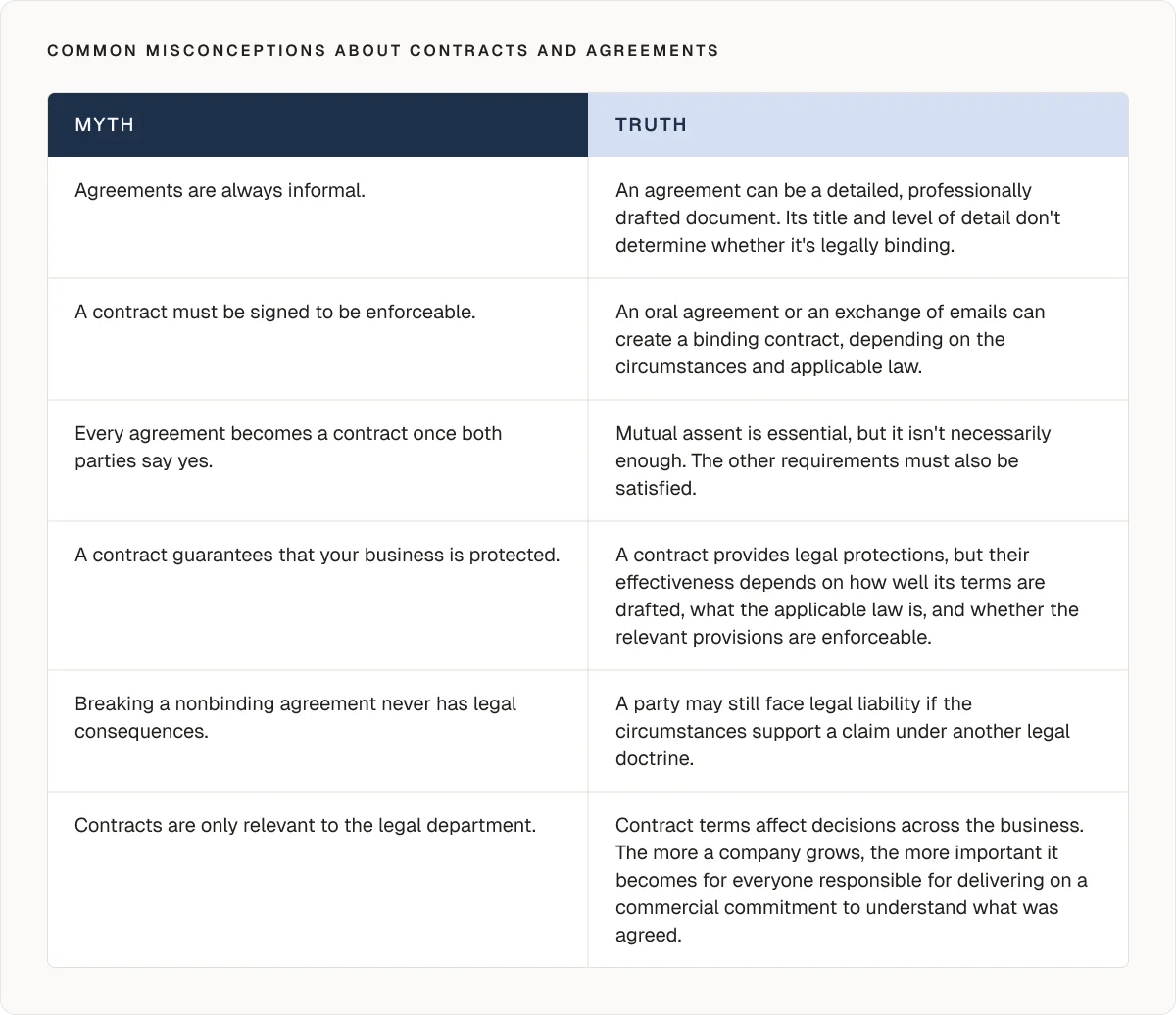
However, just because agreements can serve as preliminary arrangements doesn’t mean they can’t form the basis of a binding contract.
How to turn an agreement into a contract in 10 steps
To turn an agreement into an enforceable contract, follow these steps:
1. Define a clear offer: Specify what each party is agreeing to do, including the goods, services, or commitments involved. Well-defined terms give the other party a definite proposal to accept.
2. Obtain explicit acceptance: Ensure the receiving party accepts the offer. Under common law (e.g., service contracts), acceptance must match the offer exactly (“mirror image rule”). In sales of goods, the UCC is more flexible: An acceptance can still form a contract even if it adds or changes some terms.
3. Establish consideration: Identify what each party gives or promises in exchange for the other’s commitment. This could be money, goods, services, or another form of legally recognized value.
4. Confirm each party’s legal capacity: Make sure the parties have the legal ability to enter into a contract and understand the obligations they’re undertaking.
5. Verify the signer’s authority: If a company is involved, confirm that the person signing has authority to enter into the agreement and bind the business.
6. Ensure the contract has a lawful purpose: Check that the arrangement and the obligations it creates comply with applicable laws. An agreement to perform an illegal act can’t be enforced.
7. Make the essential terms clear: Spell out the scope of work, payment, deadlines, deliverables, and each party’s responsibilities. Definite terms help prevent misunderstandings and make the parties’ obligations easier to enforce.
8. Document the parties’ intent to be legally bound: Put the agreed terms in writing and clarify whether the parties intend to create legal obligations now or are still negotiating. A written record also helps establish what the parties agreed to.
9. Address what happens if a party breaches the contract: Include appropriate provisions on remedies, liability, termination, and dispute resolution so both sides understand their rights and options if something goes wrong.
10. Finalize and sign the contract: Have the authorized parties sign the final version and ensure everyone retains a copy.
Keep in mind that these steps reflect general US contract law principles and that requirements and exceptions may vary by state and transaction.
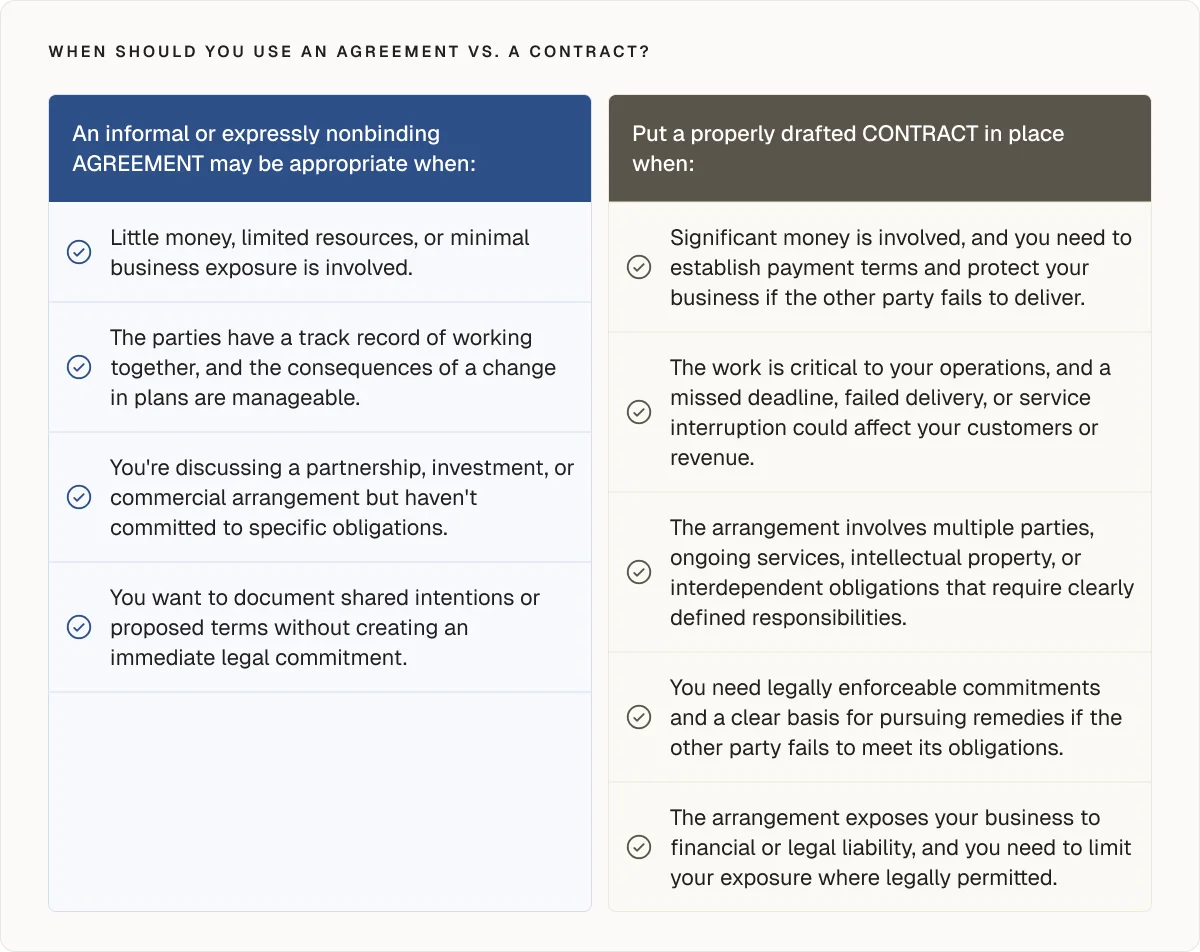
Getting every detail right, especially when dealing with complex terms, liability, or intellectual property, can be challenging without legal experience.
But working with an experienced lawyer doesn’t have to mean slow turnaround times, unpredictable hourly fees, or lengthy back-and-forth. That’s where General Legal offers a different approach.
Get startup-ready legal support with General Legal
General Legal is an AI-native law firm built for startups and growing businesses.
We combine experienced US-barred attorneys with AI-powered workflows to deliver high-quality commercial legal services at startup speed. Every matter is still led by a licensed attorney, but AI helps accelerate the work.
Whether you need to draft a contract from scratch, review a customer MSA, negotiate a vendor agreement, or get a mutual NDA in place, our attorneys can help you get the terms right without holding up the business.
Here’s what you can expect:
- Experienced legal counsel: Work directly with qualified attorneys who understand commercial contracts and the needs of growing companies.
- Faster turnaround: Expect a median first turn of three hours or less on commercial work, such as a contract review or first draft.
- Predictable costs: Get an upfront flat-fee quote before work begins, without the uncertainty of open-ended hourly billing.
- Straightforward communication: Work directly with your attorney over Slack, email, or our client portal.
Ready to get your contracts in order? Book an intro call to meet our team and discuss your legal needs. Alternatively, create your account right away to submit your request and receive an upfront flat-fee quote.
- Every contract is an agreement, but not every agreement is an enforceable contract, and mixing them up can leave a business with obligations it never intended or with less protection than it assumed.
- Courts look at a document’s actual terms rather than its label, so an LOI, MOU, or term sheet can still contain binding provisions.
- A contract needs offer and acceptance, consideration, capacity, a lawful purpose, and definite terms to be enforceable.
- Written contracts make terms easier to prove in a dispute, though emails, Slack messages, invoices, and payment records can also help show that a deal was formed.
- An agreement can become a contract by defining a clear offer, confirming acceptance and signer authority, setting out essential terms and remedies, and signing the final version.
- Requirements vary by state and transaction, so complex terms, liability, or IP issues are worth having an attorney review.
| Definitions | An agreement is mutual assent between two or more parties; a contract is an agreement that creates obligations enforceable by law. |
|---|---|
| Legal scope | “Agreement” is the broad term, while a contract is a narrower type that meets the legal requirements for formation. |
| Formality | Agreements can be informal (a handshake or emails), while contracts are usually more structured, and some, like certain real estate sales or goods sales of $500 or more, need a signed writing. |
| Enforceability | A contract must have offer and acceptance, consideration, capacity, legality, and definite terms to be enforceable. |
| Protection and remedies | Contracts allocate responsibilities and set consequences for breach; without a valid contract, remedies may be limited to doctrines like promissory estoppel or restitution. |
| Proof | Written contracts give a clear record, but emails, messages, invoices, and payments can also help establish the terms. |
| Business use | Agreements help move early negotiations forward, while contracts guide day-to-day execution across finance, sales, and operations teams. |
| Conversion steps | Turning an agreement into a contract involves a clear offer, acceptance, consideration, capacity, signer authority, lawful purpose, clear terms, written intent, breach provisions, and signing. |
Is it true that not all agreements are contracts?
Yes. Every contract is an agreement, but an agreement is only a contract if it meets legal requirements like mutual assent and consideration. Without them, it’s a mutual understanding the law may not enforce.
Is an agreement legally binding?
Not automatically. Under US law, an agreement becomes legally binding only when it meets the requirements for contract formation, such as mutual assent, consideration, capacity, and a lawful purpose.
What is the difference between a contract and a letter of agreement?
The main difference between a contract and a letter of agreement lies in their purpose and level of detail. A contract typically sets out comprehensive terms and legally enforceable obligations, while a letter of agreement outlines the terms of a specific arrangement. However, a letter of agreement can also be legally binding if it meets the applicable requirements for contract formation.
Is a memorandum of understanding a contract?
Under US contract law, a memorandum of understanding (MOU) is typically not a contract, as it generally functions as a nonbinding outline of mutual intentions and goals rather than an enforceable agreement. However, in an MOU vs. contract analysis, courts prioritize substance over title: If an MOU contains essential contract elements, it can be enforced as a legally binding contract regardless of its label.
- Contract Law vs. Commercial Law: 5 Key DifferencesCompare contract vs commercial law so you can understand their differences, identify the right legal framework & protect your business in every deal.
- Legal Contract Requirements: 8 Clauses for BusinessesExplore legal contract requirements so you can understand what makes agreements enforceable, identify key clauses, & protect your business from risks.
- MSA vs. SOW: How the two contracts work together [Explained]Discover how MSAs and SOWs work together, understand their key differences, and protect your business when managing service agreements.