
Corporate commercial law and corporate law are often used interchangeably by founders who should know better. They describe different work, involve different lawyers, and when confused, produce predictably expensive results.
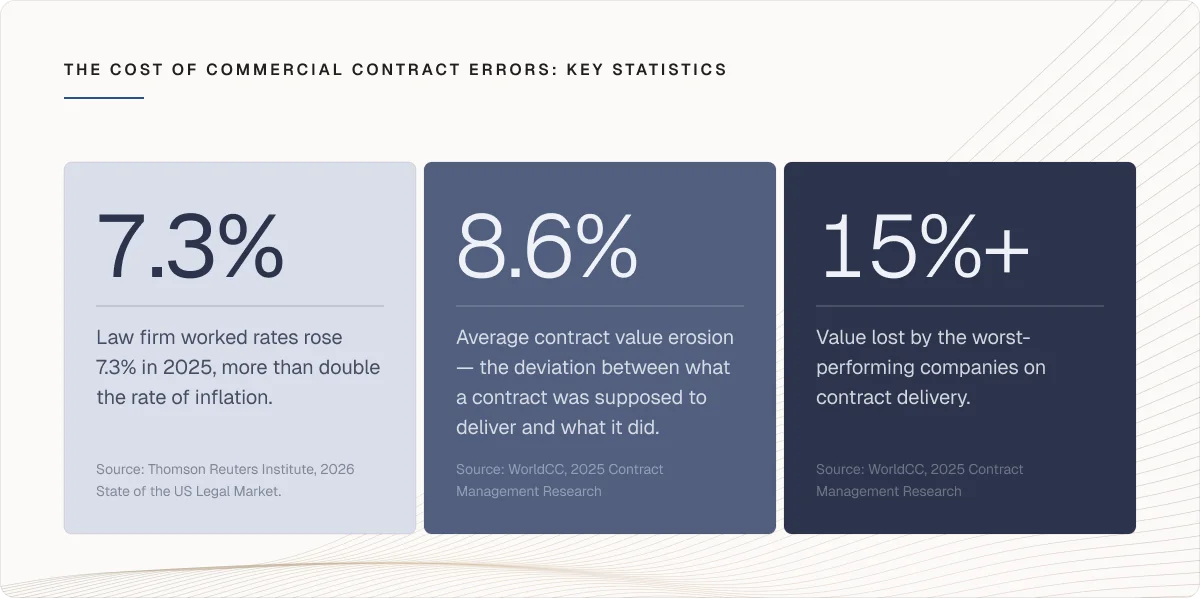
The Thomson Reuters Institute and Georgetown Law's 2026 State of the US Legal Market report found that law firm worked rates rose 7.3% in 2025—more than double the rate of inflation. Paying those rates for the wrong type of legal work is entirely avoidable.
That's why this guide draws the line between corporate commercial and general corporate law, explains where they overlap, and shows how to resource the work before it starts costing you deals.
What is corporate commercial law?
Corporate commercial law is the body of law (and the legal work) that governs how a company drafts, reviews, negotiates, and enforces the agreements that bring revenue in and send spend out.
For a startup, this means customer contracts, vendor agreements, partnerships, licensing deals, NDAs, and the terms your product ships under. Most of the work falls into four categories:
- Contract drafting and review: Covers MSAs, NDAs, data processing agreements, and vendor and customer terms, which together form the core of the practice
- Commercial disputes: Handles what happens when a contract relationship breaks down, from demand letters through litigation
- Employment and HR support: Covers offer letters, contractor agreements, and the compliance that surrounds hiring
- Compliance and risk management: Keeps the business inside privacy and regulatory lines as it scales
Contracts are central to this list, since they govern how your company does business rather than what it is.
Corporate law vs. commercial law: The actual difference
The two fields share much of the same vocabulary and often the same firm, but they govern fundamentally different things.
The table below breaks down the two fields across five different categories:
The one-sentence test
Ask whether the problem is about the company's ownership and structure, or about a deal the company is making with someone else.
Within any contract, commercial terms cover the business deal (pricing, deliverables, and timelines), typically owned by your sales or ops lead. Legal terms cover risk, liability, confidentiality, and disputes. A commercial lawyer's job is to protect you on the second set without compromising the first.
In practice, the two fields overlap more than the table suggests, and the expensive surprises usually come from that overlap.
Where corporate and commercial law overlap
These four situations are where the overlap shows up most often:
- Financings: The stock purchase agreement is corporate, but a side letter granting commercial rights, or a strategic investor who is also your biggest customer, pulls in commercial issues.
- Acquisitions: The deal itself is corporate, while diligence examines every customer and vendor contract you've signed.
- Strategic partnerships: A revenue-share agreement with equity attached sits directly on the line between the two.
- Diligence in any round: Investors read your commercial paper to judge revenue quality, so sloppy contracts become sloppy diligence.
7 agreements corporate commercial law covers
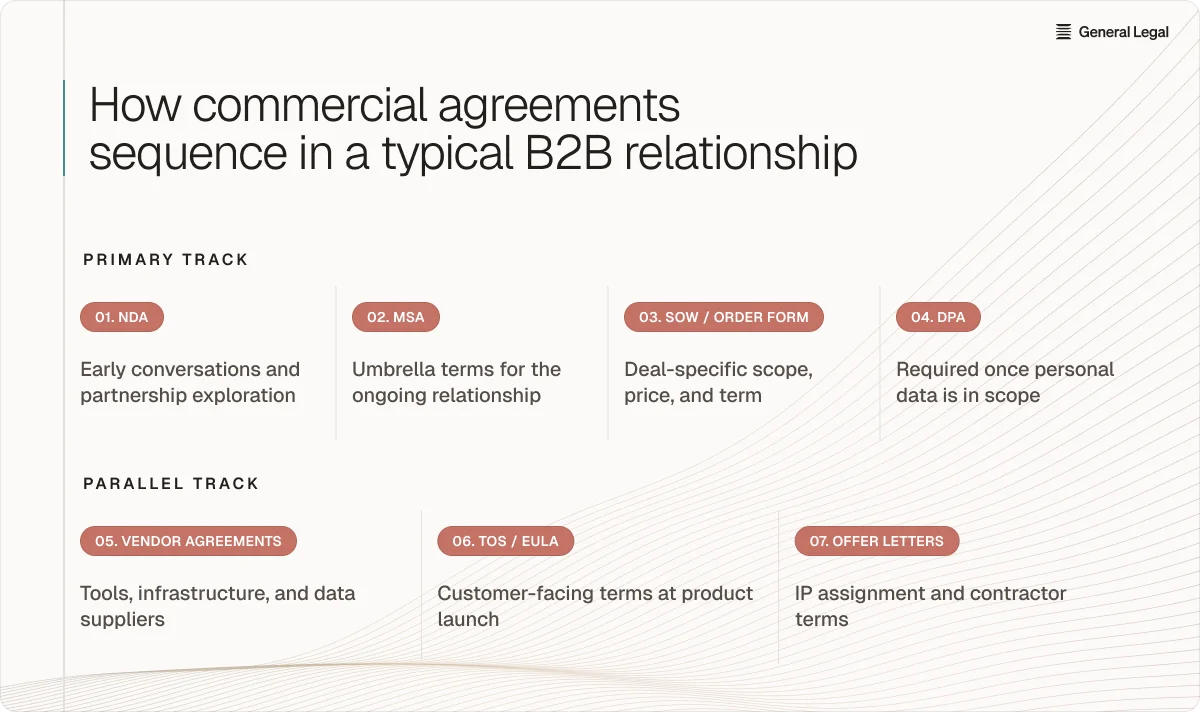
For a B2B startup, commercial legal work consists of a short stack of documents that each do a specific job. These seven account for most of it.
1. Master services agreements (MSA)
An MSA sets the umbrella terms for an ongoing customer or vendor relationship, covering payment, liability caps, indemnities, termination, and governing law. Because every later order hangs off it, a weak MSA repeats its weaknesses on every deal.
Starting from a master services agreement template helps, but most of the negotiation happens in the liability and indemnity sections.
Read more: Which MSA Clauses Can Ops Approve, and What's the RevRec Impact?
2. Statements of work (SOWs) and order forms
SOWs and order forms include deal-specific commercial terms that flow from the MSA, such as scope, price, quantity, and term. Check the order of precedence, because when an order form conflicts with the MSA, the contract should say which one wins.
3. Data processing agreements (DPAs)
A data processing agreement is required when you handle personal data on behalf of customers, and it's increasingly a gating item in enterprise procurement. Its terms have to match the promises you've made to your own customers, and US and EU DPAs differ in ways that matter once a customer operates in Europe.
Pro tip: Have your own DPA ready before an enterprise prospect sends theirs. Negotiating from your paper is faster than redlining a document written for a much larger vendor.
4. Non-disclosure agreements (NDAs)
NDAs look simple and are routinely mishandled, particularly on term, residuals, and what counts as confidential. A mutual NDA suits most early partnership conversations, but read for non-solicitation and residuals language that turns a short agreement into something larger.
Read more: The Most Common NDA Pitfall Isn't What You Think
5. Vendor agreements
These are the terms under which you buy cloud infrastructure, tooling, data, and services. They're easy to rubber-stamp and expensive to get wrong, especially when the vendor touches customer data or limits its own liability to a month of fees.
6. Terms of service and End-User License Agreements (EULAs)
Your terms of use and end-user license agreements are the customer-facing terms your product ships under. They govern every self-serve customer who never negotiates, so one error reaches all of them at once.
7. Offer letters and contractor agreements
Offer letters and contractor agreements fall between commercial and employment work. The IP assignment language is the clause worth reading closely, since a contractor who never assigned their work can raise questions about what your company owns.
In negotiation, customers push for uncapped indemnities and net-90 payment terms, while your interests run in the opposite direction on both. A good commercial lawyer prices that risk, proposes a fallback, and gets the deal over the line.
WorldCC's 2025 contract management research puts average value erosion (the deviation between what a contract was supposed to deliver and what it did) at 8.6%, with the worst performers losing more than 15%.
Poorly drafted contracts are a leading contributor, and the problem becomes visible when the relationship breaks down and everyone starts reading the clause you skipped.
3 reasons why routing legal work properly matters for your startup
Knowing which category a problem falls into is what determines how fast it gets resolved and how much it costs.
1. Routing work correctly saves days
Corporate-focused lawyers who handle financings aren't set up for high-volume commercial paper. Commercial teams that specialize in contracts have playbooks and fallback positions for the clauses that come up most. Understanding the category lets you send the work where it gets done fastest.
2. Legal drag becomes a revenue problem
When legal work hurts a company, it usually does so by slowing deals down at exactly the wrong moment, and the cause is almost always a commercial problem.
3. The pricing model has to fit the work
Commercial work is high-volume and repetitive in structure. According to the Thomson Reuters Institute, 90% of legal dollars still flow through hourly billing arrangements, with Am Law 100 partner rates above $1,000 an hour. Applied to a weekly stream of customer and vendor paper, the billable hour turns every contract into an open-ended cost.
Which problem goes to which lawyer
The table below covers the situations founders run into most often:
General Legal: One firm for corporate and commercial law
Splitting corporate and commercial work across firms has a cost that rarely appears on an invoice. Every handoff means re-explaining the company, and the lawyer negotiating your customer paper often has no view of the financing that paper will later have to survive in diligence.
The fix is a single team that handles both.
General Legal is an AI-native law firm that combines US-barred attorneys with AI built specifically for legal work, serving startups and growth-stage companies.
The firm's Sentinel system handles issue spotting and a first-pass review in about 10 seconds. Attorneys then make the judgment calls, set the negotiation strategy, and complete the review.
The price is quoted upfront, so there are no open-ended costs at the end of a deal.
For companies that need both sides covered, the same team handles:
- Technology transactions: MSAs, SaaS and subscription terms, licensing and IP agreements, partnership agreements, and NDAs
- Emerging companies and venture capital: Incorporations, governance, cap table management, and financings from SAFEs through Series F
- AI data sales and licensing: Training-data licenses, dataset sales, recurring data supply agreements, and strategic data partnerships
- Data privacy: DPAs, privacy policies, and data governance terms required by enterprise customers
- Employment: Offer letters, contractor agreements, equity incentive documents, and separation agreements
- Tax: Entity structuring, QSBS planning, equity compensation, and tax considerations for financings and exits
- Financial regulatory: Regulatory questions for companies operating in financial services
Whether the work is commercial paper that needs to close this week or a financing that touches both sides of the practice, it comes in through Slack, email, or the client portal and comes back with an attorney's name on it.
If your next inbound MSA is already in your inbox, create a free account and send it over. If you want to think through your broader contract setup first, book a quick working session.
Read more: Outside General Counsel for Startups: What to Expect?
- Corporate law governs company structure and ownership (formation, equity, governance), while corporate commercial law covers revenue and vendor contracts (MSAs, DPAs, NDAs).
- Law firm rates rose 7.3% in 2025, making it critical to route legal work to the right specialist to avoid paying premium rates for mismatched expertise.
- The seven core commercial agreements for B2B startups are MSAs, SOWs, DPAs, NDAs, vendor agreements, terms of service, and employment contracts.
- Poorly drafted contracts cause average value erosion of 8.6%, with the worst cases losing over 15% of expected deal value.
- Routing commercial work to contract specialists rather than corporate lawyers saves time and money, as 90% of legal work still bills hourly at rates exceeding $1,000 per hour for top firms.
- Strategic moments like financings, acquisitions, and partnerships sit at the overlap where both corporate and commercial expertise are essential.
| Core distinction | Corporate law addresses entity structure and ownership; commercial law governs customer and vendor transactions |
|---|---|
| Cost impact | Law firm rates increased 7.3% in 2025, making proper work categorization essential to avoid overpaying |
| Commercial law scope | Covers seven key agreements: MSAs, SOWs, DPAs, NDAs, vendor contracts, ToS/EULAs, and employment documents |
| Contract value erosion | Poor drafting causes 8.6% average value loss, reaching 15%+ in worst cases |
| Routing efficiency | Commercial specialists handle high-volume contract work faster than corporate-focused attorneys |
| Overlap zones | Financings, acquisitions, strategic partnerships, and due diligence require both corporate and commercial expertise |
| Billing models | Hourly billing at $1,000+ per hour poorly suits repetitive commercial work; fixed pricing aligns better |
| Integrated approach | Single firms handling both areas prevent handoff costs and ensure contract terms survive investor diligence |
Is commercial law the same as corporate law?
No. Corporate law is about who owns and runs the company: formation, ownership, governance, and capital structure. Commercial law is about what the company agrees to with others, from customer and vendor contracts to licensing and data agreements.
What does a corporate commercial lawyer do?
A corporate commercial lawyer redlines inbound customer and vendor contracts, maintains your standard templates, and flags the clauses that need a business decision before signature. The role also covers advice on liability, confidentiality, and compliance when those contracts are tested.
Which contracts does a startup need reviewed most?
Customer MSAs, DPAs, and NDAs, followed by vendor agreements for tools that handle customer data. Anything with uncapped indemnities warrants legal review before signature.
Does commercial law apply to SaaS companies?
Yes, but pure SaaS generally falls outside Article 2 of the Uniform Commercial Code, which covers goods rather than software delivered as a service. Your warranty, remedy, and liability terms get no UCC safety net and stand entirely on what your contracts say.
Can one law firm handle both corporate and commercial work?
Yes, and for most startups it's the more practical arrangement. A single firm can check that terms you give a customer, such as exclusivity or most-favored-customer pricing, don't conflict with rights you later grant investors.
Can you use contract templates instead of hiring a lawyer?
Templates work for straightforward agreements, but they fall short on customization. Liability caps, indemnity scope, and governing law are the provisions that decide serious disputes, and those require judgment specific to your deal, your counterparty, and your risk tolerance.
- Commercial Contract Litigation: When It Happens & How to AvoidExplore what you need to know about commercial contract litigation so you can understand common disputes, manage legal risks & protect your business.
- 12 Types of Commercial Law You Should Know in 2026Explore the types of commercial law so you can understand your legal needs, manage business risks, and choose the right legal support.
- Best Fractional General Counsel for Startups: 6 Top OptionsDiscover the best fractional general counsel for startups so you can find expert legal support and manage costs.