
Landing an enterprise AI pilot is a milestone. However, it still doesn’t mean you’ve secured a customer, as plenty of promising pilots never make it to production.
According to a May 2026 Zapier survey conducted by Centiment, 38% of 835 business leaders say their longest-running active AI pilot has been stuck in evaluation for over a year.
While a pilot agreement can’t make an enterprise customer buy your product, it can set limits on what they test, for how long, and on what terms, so your startup isn’t treated like a free R&D team.
But that protection only goes as far as the terms you put in writing; your agreement should leave as little room for ambiguity as possible.
This guide covers what belongs in an AI pilot agreement and how to avoid leaving your startup exposed.
What is a pilot agreement?
A pilot agreement is a short-term contract between a startup and a prospective customer that sets the terms for testing a product, service, or technology before either party commits to a longer-term commercial relationship.
The customer gets to assess whether the technology works in its environment, while the startup gets an opportunity to demonstrate its value, gather feedback, and potentially secure a commercial contract.
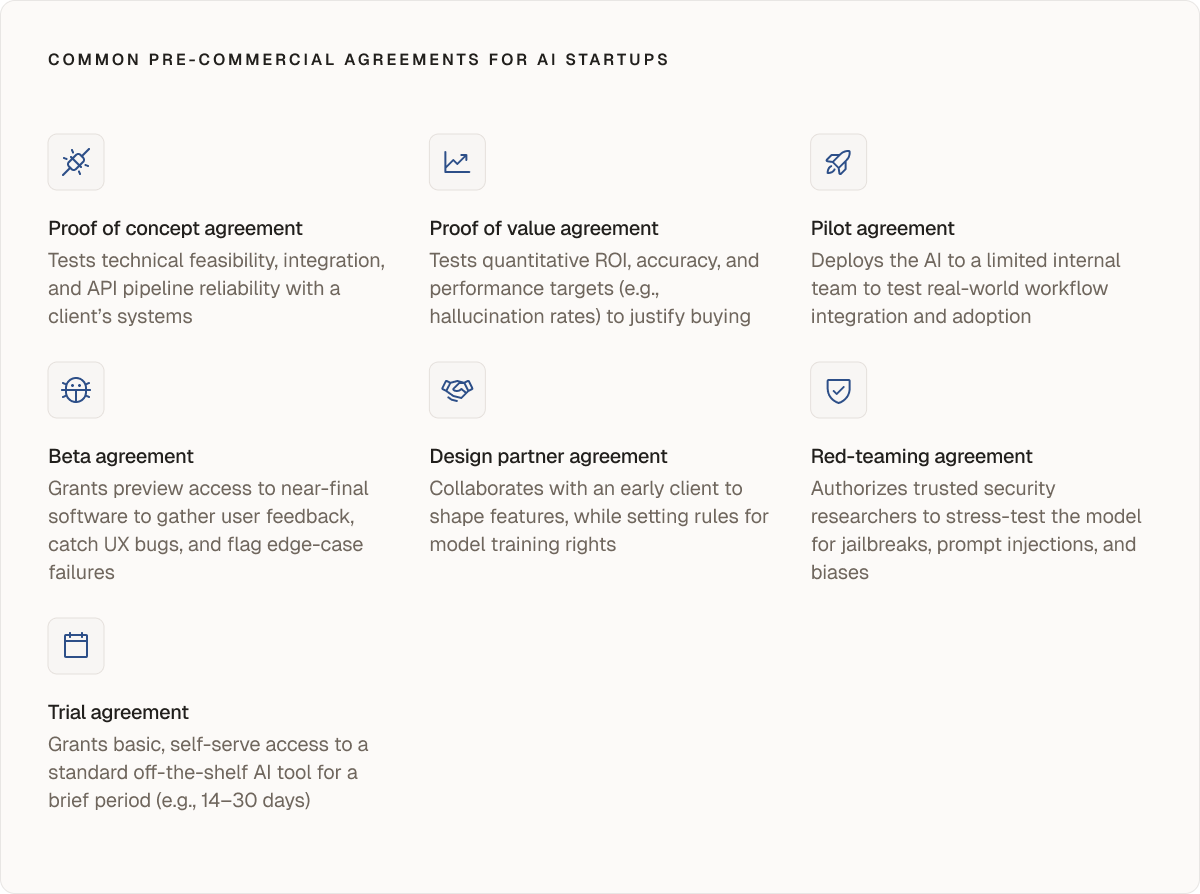
However, keep in mind that the path from a pilot to a commercial contract may involve several other stages of testing and evaluation, each governed by a different agreement.
In the pre-commercial evaluation process, a pilot agreement may be preceded by proof of value and proof of concept agreements, while trial and beta agreements may govern other forms of early product testing.
What to include in an AI pilot agreement: 7 key sections
A well-structured AI pilot agreement gives both sides a clear framework for testing the product, managing expectations, and deciding what comes next.
Given how much longer enterprise AI purchases take than standard software purchases, this level of clarity is essential.
A June 2026 Levelpath survey found that the most common purchasing timeframe for AI software was 16–20 weeks, compared with 7–10 weeks for standard software purchases over $10,000. Across software purchases generally, 52% of buyers said contract negotiations had delayed or derailed a deal in the past year.
By including the following provisions, you can address key issues upfront, reduce friction during negotiations, and protect your startup throughout the evaluation.
1. Pilot scope, access, and permitted use
Your pilot agreement should define exactly what the customer is allowed to test and who can access it.
Without clear boundaries, a limited evaluation can gradually expand into broader use before your startup has agreed on the commercial terms or the resources needed to support it.
The relevant provisions should cover:
- Evaluation purpose and scope: Limit use to evaluating the product for a potential commercial relationship. Define the features, use cases, and business purposes covered.
- License and access rights: Grant a limited, non-exclusive, non-transferable, non-sublicensable license for the pilot period. Specify whether access is through SaaS or an installed version.
- Authorized users: Set limits on user seats, teams, business units, and locations. Address account security and the customer’s responsibility for user activity.
- Environments and usage limits: Specify whether testing can take place in production or only in a sandbox. Set technical limits on API calls, user activity, and system access to keep the evaluation within its agreed scope.
- Use restrictions: Prohibit unauthorized access, redistribution, copying, modification, and reverse engineering. For AI products, address attempts to extract models or underlying technology and use the product to develop a competing service.
Pay particular attention to access expansion.
Company-wide or tenant-wide access can expose your startup to more usage and support demands than the pilot was designed to handle.
Pro tip:
Tie any expansion beyond the initial users or environments to performance milestones and a written amendment.
2. Pilot duration, milestones, and success criteria
Without a defined timeline and measurable goals, an AI pilot can drag on while the customer keeps testing, requesting changes, and postponing a purchasing decision.
To prevent this scenario, your agreement should establish:
- Pilot period: Set a fixed start date and end date, including any implementation period that affects the evaluation timeline.
- Milestones and deliverables: Identify the main stages of the pilot, expected deliverables, and each party’s responsibilities for reaching them.
- Success criteria and performance metrics: Define measurable acceptance criteria in advance, preferably in an attached Statement of Work (SOW). For AI products, specify how the system will be evaluated for accuracy, hallucination rates, performance, and edge-case failures.
- Testing methodology: Agree on the evaluation dataset, testing conditions, and process for measuring results so neither party can change the definition of success midway through the pilot.
- Extensions and end-of-pilot decision: State whether the pilot can be extended, under what conditions, and when the parties must decide whether to end the evaluation or proceed with commercial negotiations.
The end date needs a commercial consequence.
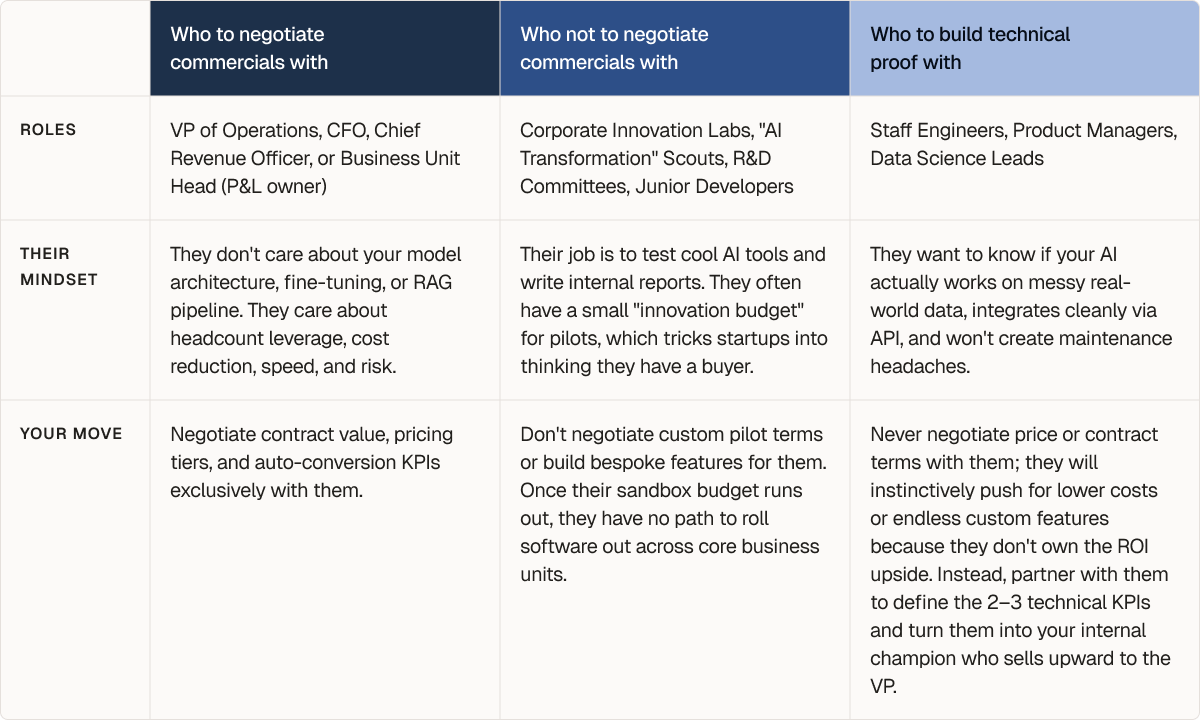
Pilots often stall after the technical evaluation is complete, while the customer delays its purchasing decision. A fixed deadline, with extensions requiring written agreement and ideally additional payment, helps prevent that drift.
3. Fees, expenses, and commercial conversion
Whether your AI pilot is free, discounted, or paid, the agreement should make the financial commitment clear from the outset.
AI products can also generate variable costs through model usage, API calls, infrastructure, and implementation, so leaving expenses undefined can quickly eat into a startup’s margins.
Key financial provisions for your pilot agreement include:
- Pilot fees: State whether the pilot is free or paid. If charging, specify whether the fee is flat, monthly, or usage-based, and set out the amount and payment schedule.
- Expenses: Allocate responsibility for implementation, hosting, servers, licenses, travel, training, and additional support. Specify which expenses require prior approval.
- Usage charges and cost limits: Address charges tied to API calls, tokens, or other consumption-based usage. Set spending caps or require customer approval before usage generates additional charges.
- Conversion to a paid contract: Explain what happens if the pilot succeeds, including whether the parties will negotiate a full agreement or move to pre-agreed commercial terms.
Pro tip:
To improve the chances of converting a pilot to a paid contract, consider an opt-out conversion clause: if the pilot meets agreed KPIs by a specified date, it automatically converts to a paid subscription under pre-agreed terms. This can prevent restarting procurement and contract negotiations after a successful evaluation.
4. Intellectual property and feedback rights
An enterprise pilot can generate new features, integrations, and product improvements. Your pilot agreement should clarify who owns that work and what each party can do with feedback and other contributions.
The IP provisions should address:
- Background IP: Confirm that each party retains ownership of its pre-existing technology, software, models, data, and other intellectual property.
- Product improvements and developments: Specify who owns new features, modifications, integrations, and improvements developed during the pilot.
- Customer-specific deliverables: Define ownership of any custom work created for the customer.
- Feedback and suggestions: State whether your startup can use feedback, suggestions, and recommendations from the customer to improve its product. If so, make clear that it can do so without transferring ownership of the customer’s pre-existing IP or confidential information.
Watch for broad IP assignment language.
A customer may ask to own all work developed during the pilot, which could sweep in improvements to your core product. Make sure your startup keeps ownership of its underlying technology, models, and general product improvements, including those informed by the customer’s use.
5. Data rights, privacy, and security
AI pilots can involve sensitive customer information moving through your product, your infrastructure, and third-party model providers. The agreement needs to account for each stage of that data flow, including what happens after the pilot ends.
Pay particular attention to these terms:
- Customer inputs and generated outputs: Establish who owns the data and outputs created through the pilot. Enterprise customers will generally expect to retain ownership of their proprietary inputs and generated outputs.
- Permitted data use: Define how your startup may process customer data to provide the service, and whether it can use that data for any additional purpose.
- Model training and fine-tuning: Address expressly whether customer data can be used to train or fine-tune models. If the customer agrees, specify which data may be used and any restrictions on that use.
- Aggregated and de-identified usage data: Specify whether your startup can retain and use aggregated, de-identified telemetry for product analytics, performance monitoring, and service improvement, subject to safeguards against identifying the customer or its users.
- Security commitments: Describe the safeguards your startup must maintain when handling customer data, and avoid agreeing to security requirements that exceed your actual capabilities.
- Subprocessors and third-party model providers: Identify relevant third-party providers or establish how they may be engaged, including any disclosure, approval, or flow-down requirements.
- Retention, deletion, and return: Set out how long customer data may be retained, when it must be deleted or returned, and how deletion obligations apply to backups and third-party providers.
- Privacy and industry-specific requirements: Account for applicable privacy laws and any sector-specific rules triggered by the customer’s data or use case.
If your startup processes personal data on the customer’s behalf, you may need a separate Data Processing Addendum (DPA) covering processing instructions, security measures, subprocessors, and data subject requests. Settle this before the pilot begins, not during the customer’s security review.
Download a free DPA template:
6. Warranties, liability, indemnification, and insurance
A pilot may involve an AI product that’s still being tested in real-world conditions.
The agreement should spell out what your startup promises about the product and who bears the financial consequences if something goes wrong through the following:
- Product warranties and disclaimers: Define any express warranties your startup is making and avoid promising that the product will be error-free, uninterrupted, or suitable for every intended use.
- As-is and as-available language: Consider providing the product on an “as-is” and “as-available” basis for evaluation, with appropriate disclaimers of express and implied warranties to the extent permitted by applicable law.
- Limitation of liability: Set a cap on each party’s total liability under the agreement. The cap may be tied to the fees paid or payable under the pilot, although the appropriate amount will depend on the deal.
- Excluded damages: Address whether either party can recover indirect, incidental, consequential, special, or punitive damages, as well as lost profits or revenue.
- Indemnification: Specify which third-party claims each party must cover, such as claims arising from IP infringement, bodily injury, or certain data breaches, and define any applicable limits.
- Insurance: Identify any required coverage, such as general liability, professional liability, product liability, or cyber insurance, and confirm that the requirements match the risks and scale of the pilot.
- Regulatory compliance: Allocate responsibility for complying with applicable laws and industry-specific requirements.
If your startup handles protected health information on behalf of a HIPAA-covered entity or another business associate, the parties generally need a Business Associate Agreement (BAA) in place before that data is handled.
7. Confidentiality, termination, and post-pilot obligations
Without pre-defined exit terms, a short-term pilot can leave behind ongoing access, unresolved data obligations, or disputes over what either party can continue using.
So, make sure the agreement addresses:
- Mutual confidentiality obligations: Require both parties to protect the other’s confidential information and use it only for the agreed purpose.
- Permitted disclosures and exceptions: Allow disclosures to employees, contractors, and professional advisors who need the information and are bound by confidentiality obligations. Include standard exceptions for information that’s public, already known, independently developed, or rightfully received from another source, as well as disclosures required by law.
- Termination for convenience and for cause: Specify whether either party can terminate without giving a reason, and identify the breaches or other events that allow termination for cause.
- Notice and cure periods: Set out the required written notice and give the breaching party a reasonable opportunity to fix a curable breach before termination.
- Access revocation and product removal: Require the customer to stop using the product when the pilot ends, revoke user access, and uninstall or return any software or equipment provided for the evaluation.
- Survival of obligations: Identify which provisions remain effective after expiration or termination, including confidentiality, IP ownership, payment obligations, and liability limitations.
Pro tip:
Agree on publicity rights before the pilot begins. Enterprise customers often restrict naming them or discussing results, so if you want to use their name, logo, or results in marketing, negotiate express permission in the agreement.
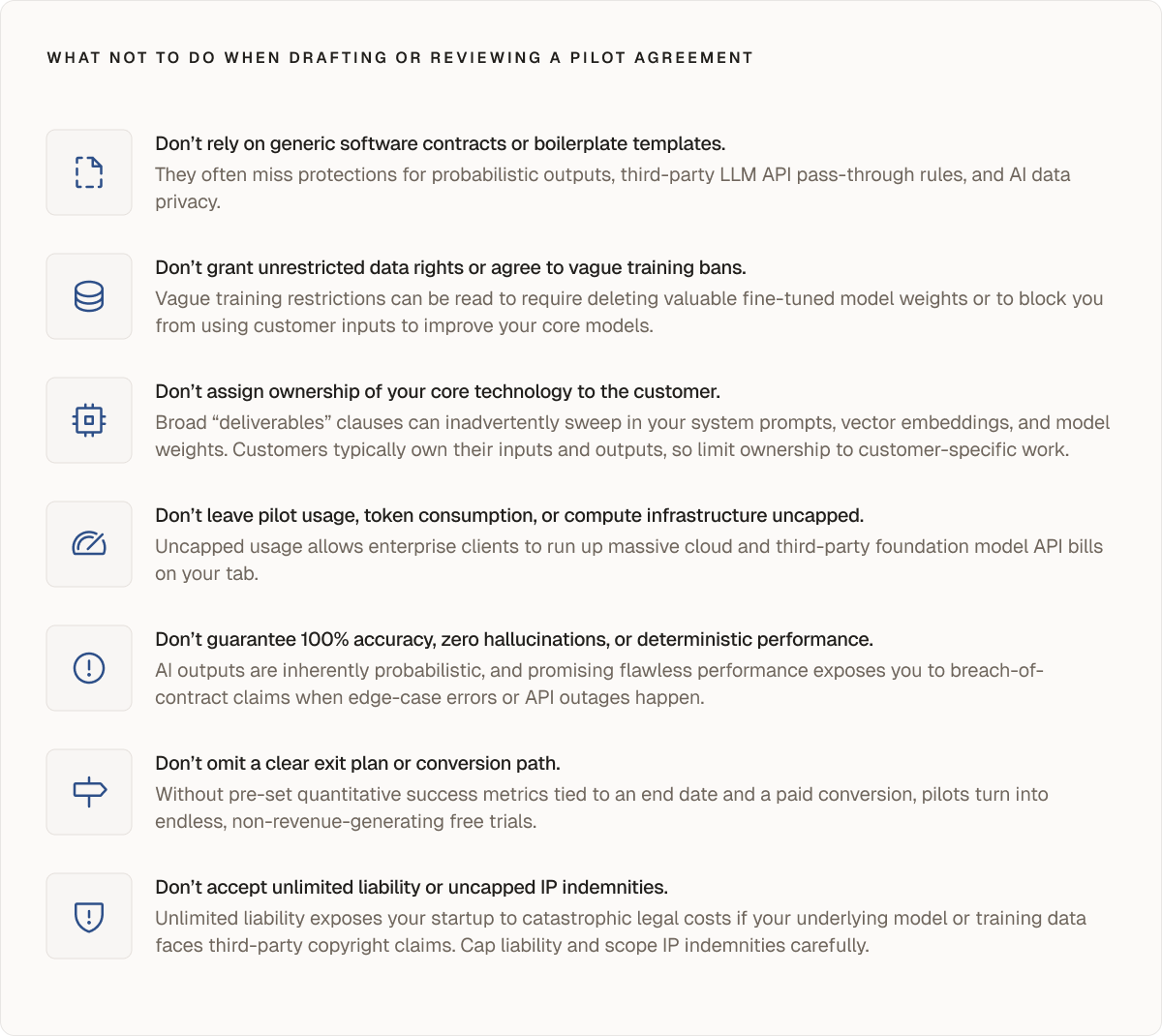
Because these terms interact, a gap in one can undo protection in another, which is why many AI startups have an attorney review the pilot agreement before signing.
Why partner with General Legal for pilot agreements
A DIY pilot agreement template can give you a starting point, but it won’t account for the specifics of your product, customer data, model licenses, IP rights, or commercial goals.
You need legal counsel that understands both the contract and the business you’re building.
Traditional law firms can provide that judgment, but hourly billing and longer turnaround times don’t always suit routine commercial work at startup pace.
General Legal offers another option: an AI-native law firm combining experienced, US-barred attorneys with AI-powered workflows to deliver high-quality legal work faster, with flat-fee pricing quoted upfront.
AI handles the first pass (triage, issue spotting, and initial drafts), and attorneys handle the legal judgment, negotiation strategy, and final review. The result is faster contract work without compromising the quality of the advice you receive.
For AI startups, a pilot may involve third-party model licenses, customer data, training restrictions, AI-use requirements, and enterprise procurement terms. General Legal helps AI startups navigate these issues, including structuring paid data evaluations and pilots that define sample access, evaluation fees, permitted testing, confidentiality, and conversion to a full commercial license.
We can also address related agreements as the customer relationship develops, including Master Services Agreements (MSAs) and other enterprise customer contracts.
As an AI startup, you can benefit from the following services:
- AI data sales & licensing: Structure training and data license agreements, establish rights to use datasets for evaluation and fine-tuning, and review data ownership, permissions, and licensing restrictions.
- AI commercial & infrastructure transactions: Negotiate enterprise AI customer contracts, third-party model licenses, cloud and compute capacity agreements, and inference services arrangements.
- Product counsel: Review AI and agent terms, third-party model provider restrictions, vendor and subprocessor arrangements, and legal obligations tied to your product’s data flows and capabilities.
You can send over an existing customer draft for review and negotiation or have an agreement drafted from scratch.
To move forward, choose the route that works best for you: Speak with our team about your needs, or submit your contract online to get a flat-fee quote before any work begins.
- A signed enterprise AI pilot doesn’t guarantee a customer, and a pilot agreement protects a startup only as far as the terms it puts in writing.
- A pilot agreement is a short-term contract that sets the terms for testing a product before a longer-term commercial relationship, and it may follow proof of concept or proof of value agreements.
- The article recommends seven sections: scope and permitted use, duration and success criteria, fees and conversion, IP and feedback, data rights and security, warranties and liability, and confidentiality and termination.
- Defining measurable success criteria, a fixed end date, and an optional opt-out conversion clause can keep a pilot from dragging on without a purchasing decision.
- AI-specific issues need express terms, including model training on customer data, third-party model providers and subprocessors, usage cost caps, and ownership of inputs and outputs.
- Because the provisions interact, a gap in one can undo protection in another, so many AI startups have an attorney review the agreement before signing.
| What a pilot agreement is | A short-term contract that sets the terms for testing a product with a prospective customer before a commercial commitment. |
|---|---|
| Scope and access | Limit use to evaluation, set a limited license, cap users and environments, restrict reverse engineering, and tie any expansion to milestones and a written amendment. |
| Duration and success criteria | Set fixed start and end dates, milestones, and measurable criteria (such as accuracy and hallucination rates) in an attached SOW, with extensions only in writing. |
| Fees and conversion | State whether the pilot is free or paid, allocate expenses, cap usage charges, and consider an opt-out clause that converts to a paid subscription if agreed KPIs are met. |
| IP and feedback | Each side keeps its background IP, ownership of improvements and custom deliverables is spelled out, and the startup keeps its core technology and models. |
| Data, privacy and security | Address ownership of inputs and outputs, permitted use, training and fine-tuning, subprocessors, retention and deletion, and possibly a separate DPA. |
| Warranties and liability | Use as-is disclaimers, cap liability, address excluded damages, indemnification, and insurance, and have a BAA in place for protected health information. |
| Confidentiality and exit | Include mutual confidentiality, termination rights, notice and cure periods, access revocation, survival clauses, and agreed publicity rights. |
What does pilot mean in business?
A business pilot is a limited, short-term test of a product or service with a prospective customer before committing to a full commercial relationship.
What is a pilot used for?
A pilot allows a business to test a product in real-world conditions, assess its performance, gather feedback, identify issues, and determine whether it meets the customer’s needs before wider deployment.
Should a pilot be free?
Not necessarily. A pilot should be free when it requires minimal setup, support, and resources, and offers clear strategic value to your startup. Charge for it when it involves significant implementation work, customization, ongoing support, substantial compute or API costs, or access to valuable data or technology.
- 8 Best Startup Tools for Managing Contracts [Comparison]Explore the best startup tools for managing contracts so you can compare features, workflows, and legal support.
- Legal Contract Requirements: 8 Clauses for BusinessesExplore legal contract requirements so you can understand what makes agreements enforceable, identify key clauses, & protect your business from risks.
- When to Involve a Law Firm in Startup Fundraising: 10 Clear-Cut SituationsDiscover when to involve a law firm in startup fundraising so you can manage legal risks, review deal terms & protect interests.